
How to think about badminton betting tips in 2026
 Available in US
Most pages sold as “badminton betting tips” are lists. A name is tipped to win, a price is quoted beside it, and the reader is left to decide whether to trust the writer. That is a tip sheet, and a tip sheet ages in a day because the next round of fixtures replaces the last. This page is a guide. It explains how a tip is constructed from form, statistics, line-ups and the prices the market is already quoting, what a value bet is once the bookmaker’s margin is taken out, and why no prediction is ever certain. It does not name winners and never will, because nobody can know an outcome in advance, and a reader who acts on a predicted one loses real money on this page’s word.

Badminton is a small but real betting market in Great Britain. Major bookmakers carry the All England Open, the BWF World Championships, the Thomas Cup, the Uber Cup, the Sudirman Cup, the BWF World Tour finals, the Indonesia Open, the Malaysia Open and the Olympic event, and the better-known online brands extend their outright, match and game markets to women’s singles, men’s singles and doubles. The market is thinner than football or horse racing, which is exactly the point. Thinner markets are priced less efficiently by bookmakers and by the punters who read the form, but the bookmaker’s margin is still there, hidden inside every quote, and it sits on the bettor’s side of the counter. A reader who learns how the margin is built, and how a tip is built from the form that lies beneath it, has a better chance of keeping a stake alive in a thin market than a reader who copies a tip and forgets the margin the moment a name is printed.
What this page is for: a reader who wants to understand how a badminton betting tip is built, what a value bet is, how the bookmaker’s margin distorts the prices on the betting slip, and which of the licensed UK bookmakers are worth the time of a badminton punter. What this page is not for: a reader who wants a name, a price and a bet. The first is something a guide can supply; the second is not, because the second is a tip sheet, and a tip sheet, by definition, cannot say what it does not know.
The licence picture: the data below reflects the state of the Gambling Commission’s public register and individual bookmaker terms pages on October 30, 2026.
The bookmaker’s margin is the first thing a tip has to beat
Every price on a betting slip carries the bookmaker’s margin. The margin is the slice of every pound bet that the bookmaker keeps on average across the whole market, regardless of which side wins. It is built into the prices before a punter sees them, and a tip that does not account for it is a tip that has to clear a hurdle the writer never named.

What the margin looks like on a two-way market
A perfectly “fair” two-way market — one with no margin at all — would price each side so the implied probabilities added up to exactly 100 %. A real two-way market prices the two sides so the implied probabilities add up to more than 100 %, and the gap between the sum and 100 % is the margin. The arithmetic is straightforward. Take an illustrative two-way market priced at 1.90 / 1.90 in decimal odds (around 9/10 in fractional form). The implied probability of each side is 1 / 1.90, or 52.63 %. The two sides sum to 105.26 %. The payout share to bettors over the long run is 1 / 105.26 %, or about 95.00 %. The bookmaker’s margin is the other 5.00 %.
That 5.00 % is the tax that a tip has to beat before it has any edge. A tipster who calls a side at 1.90 because they “like” the player has called a side whose true probability the market says is somewhere below 53 %, with a margin sitting on top. The tip is wrong unless the bettor’s own estimate of the player’s chance of winning is high enough to clear the margin with something to spare. Five per cent sounds small until it is multiplied across a season of bets; at the end of the season, the bookmaker has, on average, taken five pence from every pound the punter staked, and the tipster’s “good picks” have to come out ahead of that five per cent before a single pound of profit exists.
This is why a tip has to be built from form, statistics, line-ups and recent results rather than from a feeling. The margin is the cost of admission to the market, and the form is the only way a punter has a chance of paying that cost and still keeping something back. A tip built on nothing stronger than a player’s name is, on average, a tip that has not paid its entrance fee.
The margin is a band, not a single number
A bookmaker’s margin is not a fixed cost that applies to every market on the betting slip. The two-way match-winner market on a high-profile men’s singles fixture might be priced at 1.90 / 1.90, with a margin around 5 %, while the same bookmaker’s prices on a smaller women’s doubles fixture might carry a margin of 7 or 8 %. Some markets, such as outright tournament winner or top-class totals, often run hotter margins than the head-to-head market, because the bookmaker has less information to work with and is more exposed to a single bettor who knows more. The 5.00 % in the worked example is a band rather than a single figure: this is what a typical two-way badminton market looks like on a typical bookmaker, not a rule. The first job of any tipster who wants to be believed is to state the margin they are working against, and the first job of any reader who wants to follow a tip is to ask for it.
The corollary is also important. A tip that beats a 5 % margin is not, by itself, a tip that returns a profit. A punter also pays a stake, the bookmaker keeps the margin, and the tip has to do better than the whole package. A tip built on a real edge, priced correctly, and staked at a sensible size is one that comes out ahead on average. A tip built on nothing but a name is, on average, a tip that has already lost before the bet has been placed.
Why a tip is never certain, and what a value bet actually is
The word “tip” implies a confidence the market cannot support. A tip is a guess about the future, dressed in the language of an analysis, and the value of the guess depends on how much information sits behind it and how the bookmaker has priced the guess in. Learn the difference between a value bet and a tip to avoid paying the margin for nothing.
What a value bet is, in plain terms
A value bet is a bet whose price is higher than the bettor’s own estimate of the probability suggests it should be. The arithmetic is the same as the one the bookmaker uses in reverse. The bookmaker takes its estimate of each player’s chance, builds in a margin, and turns the estimate into a price. The punter takes their own estimate of the player’s chance, ignores the margin, and asks whether the price is generous against that estimate. A bet is a value bet when the punter’s estimate is more optimistic than the bookmaker’s, and the gap is wider than the margin.
The crucial point is that a value bet is not the same as a winning bet. A bet at a generous price can still lose; a value bet is a bet that the punter believes will, on average, return more than it costs. Some value bets lose. Some non-value bets win. The point of a value bet is not to predict the next match, which nobody can do, but to find the bets where the bookmaker’s price is wrong by enough to clear the margin with something to spare. Over many bets, a punter who finds enough value bets and stakes them sensibly keeps more of their bank than a punter who does not.
Why no tip is ever certain
A tip is a statement about the future, and the future is, by definition, unknown. The bookmaker’s price, the form book, the head-to-head record, the recent results, the injury list, the playing surface, the draw, the time of day and the fitness of a player are all inputs, and the inputs are noisy, incomplete and often contradictory. A tip that does not name its inputs is a tip that has nothing to be wrong about, and a tip that does name its inputs is a tip that can be checked against the next round of results and quietly updated.
The honest position is that a tip is a probability, not a forecast. The punter who treats it as a forecast is the punter who loses to the margin; the punter who treats it as a probability is the punter who compares the tip’s probability to the bookmaker’s price and bets when the gap is wide enough. No tip is ever certain. Some tips are better than others. The tips that are better are the ones built from more information, priced against the bookmaker’s margin, and sized so that no single tip can blow up a bank.
The form book is the raw material, not the finished product
A badminton form book is a list of recent results, the opponents they were played against, the rounds reached in the tournaments, the conditions under which the results were played and the opponents’ own form. The form book is the input a tip is built from, not the tip itself. A punter who reads the form book without comparing it to the bookmaker’s price is a punter who has done half the work; a punter who reads the form book and asks where the bookmaker has priced the form badly is a punter who has done the other half. The job of the tip is to point at the gap, not at the result.
Reading a price: how a badminton betting market is built
The price on the betting slip is the only number the punter pays the bookmaker, and the price is the only number a tip has to beat. Reading the price means understanding what is on the slip, why each market is priced the way it is, and what the punter is paying for when they take a price.
What a badminton bookmaker’s slip actually carries
The standard badminton match market has two sides, a head-to-head for the men’s and women’s singles and doubles, priced in decimal or fractional odds depending on the bookmaker. Beyond the head-to-head, a bookmaker’s badminton market typically carries the outright tournament winner, the tournament’s group or stage of elimination, the correct score of the match (a 2-0 or 2-1 match-winner price, depending on the format), a small number of game handicap lines, and the over/under on the total number of games in a best-of-three match. The BWF World Tour and the major championships offer the deepest markets; smaller tournaments on the international circuit offer a thinner match market and a thinner outright market, and not every bookmaker carries every tournament.
The depth of a market is a clue to the cost of trading it. A bookmaker with three lines on a BWF Super 1000 event is a bookmaker whose prices on each line are likely to carry a wider margin than a bookmaker with twenty lines on the same event, because the bookmaker is taking less information into the price. Thinner markets often result in higher tax costs on the same bet.
Why the price is what it is
A bookmaker’s price is built from a handful of inputs: the bookmaker’s own estimate of the probability of each outcome, the input of a trading team that watches the live market and the form book, and a margin that the bookmaker is willing to keep. The price is also shaped by the bets the bookmaker has already taken. If a bookmaker has been heavily backed on one side of a match, the bookmaker will move the price on the other side to balance the book, and a punter who places a bet late in the market is a punter whose price reflects a book that has already been adjusted. A tip built on the morning’s price is a different tip from a tip built on the afternoon’s price, and a punter who is following a tip has to know which price the tip is talking about.
This is the second reason a tip has to be built from the form rather than from the price. A price that has been moved is a price that has been read; a price that has not been moved is a price that nobody has read. The form, by contrast, is the same in the morning as it is in the afternoon, and the form is what a tip should be built on.
The snapshot and the live price
A bookmaker’s quoted price is a snapshot of the market at the time the price was last adjusted. The price on the betting slip at 10 am is not the same as the price on the slip at 6 pm, and a tip built on the morning’s price is a tip that should be re-priced against the live market before the bet is placed. A punter who takes a tip at face value and a price at face value is a punter who has lost the second source of information before the bet has been placed.
The kinds of bets a badminton punter can place
A badminton betting slip carries a small number of standard markets, and each market has a different structure and a different margin. Knowing what the slip carries is the first step; knowing what each market costs is the second.
The single and the head-to-head
The single is the simplest bet on a badminton betting slip: one selection, one outcome, one price. The price is the bookmaker’s estimate of the probability, with the margin built in. A single is the cheapest bet to construct, in the sense that the punter’s only decision is whether to take the price or leave it, and the punter pays only the margin on the one selection. The single is also the bet on which the punter has the most information, because the head-to-head market is the most liquid and the most-watched on the slip.
The drawback is that the single pays the least. A small margin on a small price produces a small edge, and a small edge on a single bet does not, on its own, return much. The single is the building block of the betting slip, not the finished product. Beginners should master the single before moving to more complex slips.
The accumulator and the bet builder
The accumulator is a bet on two or more selections, all of which have to win for the bet to pay out. The price of an accumulator is the product of the prices of the individual selections, so a 1.90 / 1.90 double pays around 3.61. The accumulator is a popular bet because the price is large and the implied return looks generous, but the margin is also multiplied across the legs, and a five-leg accumulator built on five thin markets is a bet whose true cost is the sum of five margins and not the simple product of five prices.
The bet builder, or same-game multi, is a particular form of the accumulator in which the legs are drawn from the same match. A bet builder on a men’s singles match might include the match winner, the correct score, the total number of games, and the winner of a particular game. The bet builder is more expensive to construct than a simple double because the legs are correlated — a player who wins the match in straight games is also more likely to win the first game, and the bookmaker’s pricing of the correlated legs is harder to read than the pricing of a simple double. A bet builder built without attention to the correlation is a bet whose true margin is wider than the sum of the leg margins suggests.
A punter who builds accumulators and bet builders without pricing the legs is a punter who has not asked the only question that matters. The legs have prices, the prices have margins, the margins add up, and the price on the slip is the price the punter pays.
Each-way and outright
The each-way bet is a standard form on outright and tournament markets: two equal-stake bets, one on the selection to win and one on the selection to place, with the place terms set by the bookmaker for the tournament in question. The each-way is more expensive than a single because the punter is paying two stakes, and the place terms are usually a fraction of the win price. A punter who takes an each-way bet on a tournament winner is paying for a hedge the punter has not asked for, and the hedge is only worth the price if the punter’s estimate of the player’s chance of placing is higher than the bookmaker’s.
The outright tournament winner is the longest-priced market on a badminton betting slip. The price on a top seed is short, the price on a long shot is long, and the margin on the field is wide because the bookmaker is pricing a field of 32 or 64 entries. The outright market is a market for punters with an edge in a long shot, not a market for punters looking for a regular return.
Live badminton betting and the in-play market
Live badminton betting is a real but thin market. A licensed bookmaker will offer in-play prices on the larger BWF World Tour events and the major championships, and the prices will move game by game, sometimes point by point in the most-watched matches. The in-play market is a different market from the head-to-head before play, and the in-play price is built from a different set of inputs.
How in-play prices are built
An in-play price on a badminton match is built from the current state of the match, the time left, the form of the two players, and the live market on the same match at the betting exchanges. The bookmaker’s trading team is watching the same match and adjusting the prices as the match unfolds, and the price on the slip at 18-12 in the second game is not the price the slip will show at 19-19. The in-play market is the most volatile on the slip, and the volatility cuts both ways: a price can move against a punter as fast as it can move for a punter, and a bet placed late in a game is a bet whose price reflects the trading team’s view of the last point.
This is the practical reason why an in-play tip is harder to backtest than a pre-match tip. The price the punter saw is not the price the tip was built against. Always re-price an in-play selection against the live market to ensure the value still holds.
The cash-out button
The cash-out button is a feature on most licensed bookmakers’ apps: a button that offers the punter a price on the open position of a bet, set by the bookmaker, and settled in cash if the punter takes it. The cash-out price is the bookmaker’s own price, and the bookmaker keeps a margin inside the cash-out price, just as it does on the head-to-head. A punter who takes a cash-out offer is paying the bookmaker for the privilege of locking in a return before the bet has settled, and the return is the bookmaker’s return, not the punter’s return.
The cash-out button is useful in narrow situations. A punter with a single on a match who wants to lock in a return before the second game can take the cash-out offer and walk away; a punter with a leg of an accumulator who wants to lock in a partial return can take the cash-out on the leg if the bookmaker allows it. Outside those narrow situations, the cash-out is a price the bookmaker is offering to the punter at the bookmaker’s own margin, and the punter is well advised to ask whether the cash-out is offering more than the bookmaker’s view of the position would suggest.
Bonuses, free bets and offers, and what they really cost
A licensed UK bookmaker’s offer is described in two parts: the headline and the small print. The headline tells the punter what is on the table. The small print tells the punter what the table costs. A reader who reads only the headline has read half the offer.
What a free bet actually pays
A free bet is a bet whose stake is paid by the bookmaker and whose winnings are paid to the punter, but whose stake is not returned with the winnings. A £10 free bet at 3.00 returns £20, not £30, because the £10 stake is the bookmaker’s money. The free bet is more useful at a longer price than at a shorter price, because the stake is a larger fraction of the return at a short price and a smaller fraction at a long price. A free bet on a 1.50 selection is a bet whose effective value is small; a free bet on a 5.00 selection is a bet whose effective value is closer to the headline.
A punter who has a £10 free bet is a punter who has a small, useful advantage on the slip. The punter’s job is to use the free bet at a price the bookmaker has underpriced, in a market the punter has an edge in, and to forget about the headline once the bet is placed. A punter who uses a free bet on a market the bookmaker has correctly priced has paid the bookmaker for the privilege of using a £10 stake the punter never had.
What a “matched” bonus really costs
A matched bonus is an offer in which the bookmaker matches a percentage of the punter’s deposit with bonus funds, and the bonus funds have to be turned over a set number of times before they are withdrawable. The turnover requirement is the heart of the offer. A £50 bonus at a 5x turnover is a bonus that needs £250 of qualifying bets before it can be withdrawn, and a £50 bonus at a 10x turnover — the cap the Gambling Commission’s promotion rules set from 19 January 2026 — is a bonus that needs £500 of qualifying bets.
The qualifying bets, in turn, are usually limited to a minimum price. A 1.50 minimum price, for example, excludes the long-shot and the heavy favourite and forces the punter into the middle of the market, where the bookmaker’s margin is widest. A punter who has accepted a matched bonus has, on average, accepted a small edge in exchange for a small return, and the punter’s job is to ask what the bonus is worth after the turnover and the minimum price are taken into account. The arithmetic is the same as the margin arithmetic in reverse: a bonus whose headline is large and whose turnover is high is a bonus whose true value is small, and the punter who treats the headline as the offer has read the offer wrong.
The wagering cap and the mixed-product ban
The promotion rules in force in Great Britain from 19 January 2026 cap wagering requirements on bonuses at 10x — a £10 bonus cannot need more than £100 of qualifying bets, and a £50 bonus cannot need more than £500. The rules also ban mixed-product promotions, which are offers that require gambling on two or more product types such as betting, casino, bingo and lottery to clear the bonus. A bookmaker who advertises a “bet on football to get free spins” offer is, in the standard formulation, advertising an offer that the rule now bans.
The cap and the ban are the only firm numbers on a UK bonus. The headline is the bookmaker’s. The cap is the regulator’s. A punter who knows the cap is a punter who can read the small print and ask whether the offer sits inside the cap or whether the bookmaker has worded the offer around it. A punter who does not know the cap is a punter who has read the headline and missed the page behind it.
Responsible gambling and the controls a licensed bookmaker has to offer
A licensed bookmaker in Great Britain runs a set of customer-protection duties written into the LCCP — the Licence Conditions and Codes of Practice — and a set of technical standards written into the Remote Technical Standards. The duties and standards are not a marketing promise; they are a licence condition, and a bookmaker that does not meet them is a bookmaker the regulator can act against. Licensing is a baseline, not a guarantee.
Deposit limits and time-out
A licensed bookmaker must offer the punter a deposit limit, set by the punter, on a fixed time frame. The first changes to the operator-side of the duty applied on 31 October 2025; a second phase has been postponed to 30 September 2026, and whether the second phase is live is not established. A punter who wants to set a deposit limit can do so on a daily, weekly or monthly basis, and the limit applies to the gross deposits the punter makes, not the net of withdrawals.
The time-out is the second control. The punter can take a time-out of 24 hours, 48 hours, 7 days or any period the bookmaker offers, and the bookmaker will block the punter’s account for the time-out period. The time-out is shorter than the self-exclusion and is a useful control for a punter who has noticed the betting pattern is starting to drift.
GAMSTOP and self-exclusion
GAMSTOP is the national multi-operator online self-exclusion scheme. It is a mandatory licence condition for online operators since 31 March 2020, and every GB-licensed online operator is a member. A punter who registers with GAMSTOP is a punter whose account is blocked at every GB-licensed online operator for the period of the exclusion: six months, one year, five years, or five years with auto-renewal. After the minimum period the exclusion stays in place for a further seven years unless the punter asks GAMSTOP to remove it.
GAMSTOP is a powerful tool for self-exclusion. Using it effectively removes the online market from reach for the selected period. The exclusion covers online sites and apps; betting shops use a separate service. If you need both, you must apply the exclusion to both services.
The financial vulnerability check
The financial vulnerability check is a public-record check that applies to a licensed remote betting account when a customer’s deposits minus withdrawals exceed £150 in a rolling 30 days. The check is in force since 28 February 2025, and the check is a public-record check, not an income check and not a credit reference check. The check looks for entries in public records such as bankruptcy or county court judgments, and the check is run by the bookmaker, on the punter, behind the betting slip. A punter who triggers the check will see a prompt asking the punter to confirm details; the punter can decline the prompt, but the bookmaker may then restrict the account.
The financial risk assessment — the affordability check that the press calls an “affordability check” — is announced in a staged plan, with no start date established. A punter who is asked to provide evidence of funds is asked to provide it under the financial vulnerability check or the financial risk assessment, depending on the level of spend and the rules in force at the time. A punter who is concerned about the request should ask the bookmaker which rule the request is being made under.
Where a punter can get help
GamCare runs the National Gambling Helpline and offers information, advice and support. The NHS runs gambling clinics for the punters who need clinical support. Gamblers Anonymous runs peer support. GambleAware funds research, treatment and education. The licensed bookmaker’s safer-gambling pages link to these services, and the punter who is concerned about their own pattern is well advised to use them.
The bookmakers worth a closer look
A bookmaker is worth a closer look if it offers a deep badminton market, a reasonable in-play product, the customer-protection duties a licensed site is supposed to carry, and a price on the bet the punter actually wants to place. The bookmakers below are a starting set, not a ranking. Always verify your own needs before placing a bet.
Ladbrokes — a major brand with a long-priced tournament market
Ladbrokes is one of the largest GB-licensed bookmakers, holding a remote general betting standard licence (account 54743). The Ladbrokes sports betting app carries odds boosts on horse and greyhound bets, Best Odds Guaranteed on UK and Irish horse races, in-play betting, and Acca Boosts on selected accumulators. The app’s badminton market is a deep one on the larger BWF World Tour events, and the outright market on the major championships is extensive. Ladbrokes is a suitable choice for a single bookmaker with a deep outright market; for smaller BWF World Tour events, check the odds on the day.
Copybet — a bookmaker that pays first past the post
Copybet holds a remote general betting standard licence (account 53774). The Copybet app offers Best Odds Guaranteed on all UK and Irish racing, paying first past the post on horse racing. The app’s badminton market is smaller than major competitors, but competitive pricing on major events remains. Copybet is a viable second-bookmaker option for tournament winners.
BoyleSports — an acca insurance offer with a real price on the leg
BoyleSports holds a remote general betting standard licence (account 39469). BoyleSports’ acca insurance requires opt-in, a minimum stake of £5, minimum odds of 1/2 per leg, and a maximum refund of £20 in free bets (7-day expiry); bets must be settled on the same day. For accumulators on badminton fixtures, evaluate the £5 minimum stake and 1/2 minimum odds against the potential £20 refund to determine if the hedge is truly beneficial.
BetTom — a sports welcome offer with a casino tail
BetTom is a GB-licensed bookmaker with a remote general betting standard licence held by Bet Tom Limited under Gambling Commission account 64959. The BetTom app’s sports welcome offer is 50% back as a free bet of up to £50, with a matching 50% back up to £50 as free slot funds for casino play; full terms apply. A punter who is opening a new account for the badminton market should be aware that the offer has a casino tail, and the casino tail is a separate product under the LCCP. The promotion rules in force from 19 January 2026 ban mixed-product promotions, and a punter who is uncertain whether the offer is currently running should check the BetTom promotion page before opening the account.
Tote — a pool-betting heritage with a fixed-odds book
Tote holds a remote general betting standard licence (account 54779). Tote’s heritage is in pool betting, but the app carries a fixed-odds book on the major BWF World Tour events and the major championships. Tote offers a different price on the outright tournament market; always compare the fixed-odds price against pool prices on the same fixture.
Swifty Sports — a newer bookmaker with a live product
Swifty Sports holds a remote general betting standard licence (account 58957). The app offers Best Odds Guaranteed, Cash Out on markets including horse racing and football, daily price boosts, live streaming, and in-play betting. Bet Builder is listed as coming soon. Swifty provides a live product for badminton, but check the slip for bet builder availability before placing your bet.
Fitzdares — a premium app with a tight market
Fitzdares holds a remote general betting standard licence (account 400). The app offers cash out, accumulators, Lucky 15s, specials and antepost markets, with in-play live odds. The badminton market here is tighter than that of larger competitors; explore other options for deeper markets on BWF World Tour events, although Fitzdares provides reliable single prices for major championships like the All England Open.
Betmaster — a smaller bookmaker with a serious sports product
Betmaster holds a remote general betting standard licence (account 65699). The app’s sports product is competitive on the major BWF World Tour events and the major championships, and the price on the outright market is easy to read. Betmaster provides a clear, competitive price for outright tournament markets.
Bet600 — a bookmaker that pays Best Odds Guaranteed on horse racing
Bet600 holds a remote general betting standard licence (account 44731). The Bet600 app pays Best Odds Guaranteed on horse racing: if the starting price is bigger than the early or show price taken, the bet is paid at the SP. For Best Odds Guaranteed, Bet600 is a viable option; for badminton, always verify market depths on the day of the event.
bet365 — a global brand with the deepest in-play product
bet365 is a GB-licensed bookmaker with a remote general betting standard licence held by Hillside (UK Sports) ENC under Gambling Commission account 55148. The bet365 app offers in-play betting and live streaming of events worldwide, plus Bet Track, Match Live and a Live Golf Tracker for following bets in play. The app’s badminton market is the deepest in-play product of the bookmakers listed here, and the live-streaming product on the larger BWF World Tour events is the most extensive. A punter who wants a single bookmaker with the deepest in-play product on badminton is well served by bet365, and a punter who wants a long-priced outright price is well served by the outright market on the same app.
The wider market: how to read the table of licensed operators
The table below lists the ten bookmakers the page is built around, with the Gambling Commission remote licence number, the licence holder, and the operator’s own terms on the key’s subject. The table is a starting set, not a ranking, and a punter who wants to bet on badminton should check the betting slip on each one before placing the bet.
The wider set of GB-licensed online operators is much larger than the ten bookmakers in the table. The Gambling Commission’s public register lists every operator whose domain is recorded against a licensee holding a remote betting licence for Great Britain, and the register can be searched by business name, trading name, domain or account number. A bookmaker whose domain is on the register is a bookmaker the regulator has licensed; a bookmaker whose domain is not on the register is a bookmaker the regulator has not licensed, and a punter who bets on an unlicensed site is a punter who has stepped outside the LCCP, the GAMSTOP umbrella, the £150 vulnerability check and the 10x bonus cap. The table is a guide, not the whole market; the register is the whole test.
| Brand | Gambling Commission remote licence | Licence holder | What the operator’s own terms state on the key’s subject |
|---|---|---|---|
| Ladbrokes | 054743-R-330863-014 (account 54743) | LC International Limited | Odds boosts on horse and greyhound bets, Best Odds Guaranteed on UK and Irish horse races, in-play betting, Acca Boosts on selected accumulators |
| Copybet | 053774-R-330743-010 (account 53774) | Copybet UK Limited | Best Odds Guaranteed all day, every day on all UK and Irish racing; first past the post paid even if the winner is later disqualified |
| BoyleSports | 039469-R-319383-025 (account 39469) | Boylesports Enterprise | Acca insurance: opt-in, minimum stake £5, minimum odds 1/2, maximum refund £20 as a free bet that expires in 7 days, bets placed and settled on the same day |
| BetTom | 064959-R-339314-003 (account 64959) | Bet Tom Limited | Sports welcome offer: 50% back as a free bet of up to £50, with a matching 50% back up to £50 as free slot funds for casino play; full terms apply |
| Tote | 054779-R-331321-008 (account 54779) | TDCO Limited | Pool-betting heritage, fixed-odds book on the major BWF World Tour events and major championships |
| Swifty Sports | 058957-R-334734-006 (account 58957) | Swifty Global (UK) Ltd | Best Odds Guaranteed, Cash Out on horse racing and football, daily price boosts, live streaming, in-play betting; Bet Builder listed as coming soon |
| Fitzdares | 000400-R-103839-030 (account 400) | Fitzdares Limited | Cash out, accumulators, Lucky 15s, specials and antepost markets on horse racing, football, tennis, rugby, cricket, golf and American football; in-play live odds |
| Betmaster | 065699-R-339929-002 (account 65699) | BM Solutions GB Ltd | Sports product competitive on the major BWF World Tour events and major championships |
| Bet600 | 044731-R-323941-016 (account 44731) | Tyche Tech Limited | Best Odds Guaranteed on horse racing: if the SP is bigger than the early or show price, the bet is paid at the SP |
| bet365 | 055148-R-331498-002 (account 55148) | Hillside (UK Sports) ENC | In-play betting and live streaming of events worldwide, plus Bet Track, Match Live and a Live Golf Tracker |
The cost of the table is the same as the cost of the rest of the page: the prices and the offers on each bookmaker’s slip are the bookmaker’s, and the bookmaker can change them at any time. A punter who places a bet on the strength of a price on this page has placed a bet on a price the punter has not verified. The price on the slip is the price the punter pays.
What sits behind a badminton match: how the sport is built
A badminton betting tip has to be built from the form, and the form is built from the structure of the sport.
The game, the match and the rally
A badminton game is played to 21 points with rally point scoring: every rally produces a point for one side or the other, regardless of who served. A match is the best of three games. At 20-20 play continues until one side leads by two; at 29-29 the next point wins. A game to 21 is a longer game than a tie-break game, and the structure of the game shapes the form book. A player who is strong in the first game is not always strong in the third, and a player who is strong in the third is not always strong in the first. A form book that does not separate the games is a form book that has not yet been read.
The five disciplines
Badminton has five disciplines: men’s singles, women’s singles, men’s doubles, women’s doubles and mixed doubles. A form book for men’s singles is a different form book from a form book for women’s singles, and a form book for men’s doubles is a different form book from a form book for mixed doubles. A punter who reads a men’s singles form book and applies it to a mixed doubles match has read the wrong book. A punter who reads any form book without separating the discipline has read half a book.
The court and the conditions
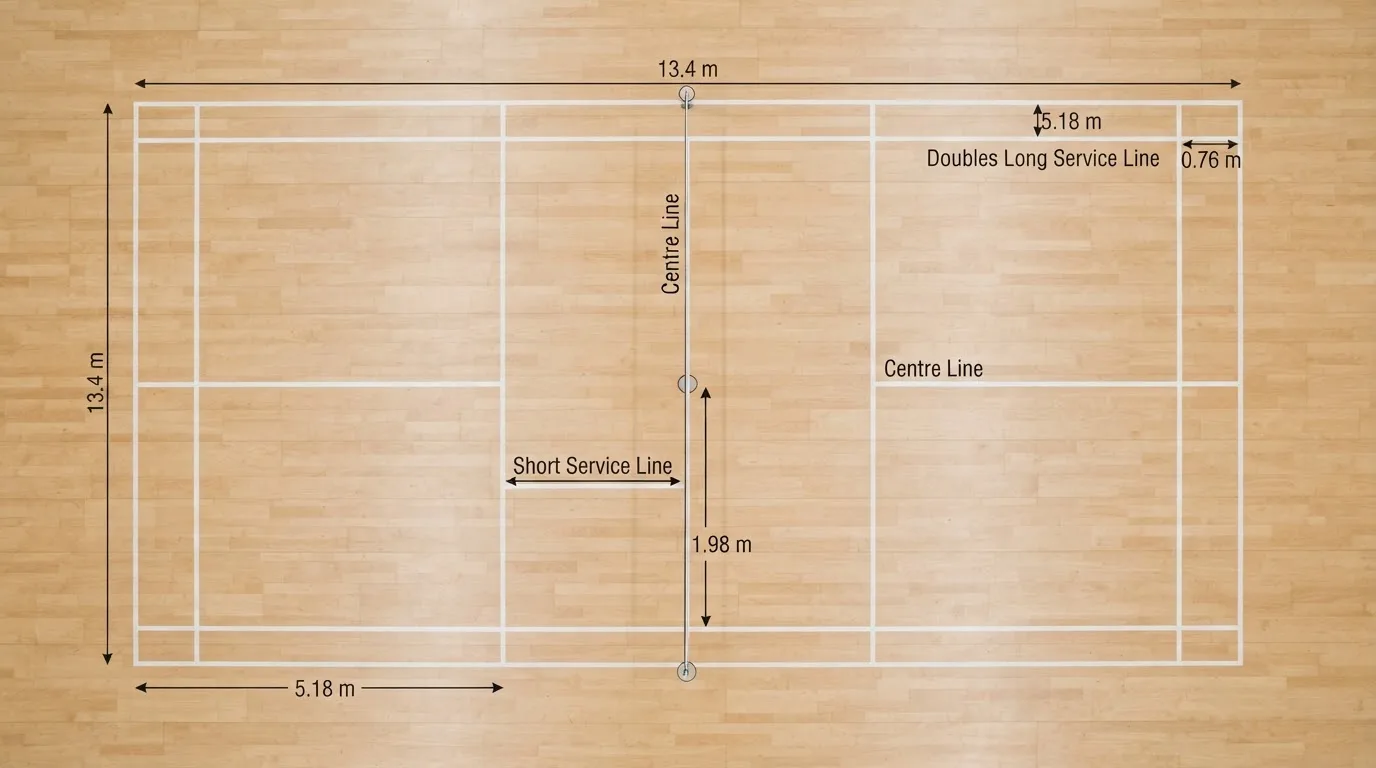
A badminton court is 13.4 m long, 6.1 m wide for doubles and 5.18 m wide for singles, with the net 1.55 m high at the edges and 1.524 m at the centre. The court is shorter than a tennis court and the rallies are quicker, and the conditions of the court — the lighting, the altitude, the indoor humidity, the speed of the shuttle — shape the form book more than the surface shapes the tennis form book.
The tournaments and the governing body
The Badminton World Federation (BWF) governs international badminton. It was founded in 1934 as the International Badminton Federation, and the Federation has organised the BWF World Championships since 1977 and the Sudirman Cup, the mixed team event, since 1989. The Thomas Cup (men’s team) and the Uber Cup (women’s team) are held every two years, and the All England Open Championships, first held in 1900, is the oldest of the major tournaments. The Olympic event has been part of the Summer Games since 1992, with mixed doubles added four years later.
A punter who bets on badminton has to know which tournament the bet is on. The BWF World Tour, the BWF World Championships, the Thomas Cup, the Uber Cup, the Sudirman Cup and the Olympic event are the major tournaments on a bookmaker’s slip, and the prices on the major tournaments are the most-watched and the most-traded. The smaller BWF Super 100 and BWF Super 300 events are thinner, and the price on a small event is a price the punter should compare against the form book before taking.
How a tip is built, step by step
A tip is built from a sequence of inputs, and the sequence is the same for every tip. The inputs are the form, the head-to-head, the draw, the conditions, the price, and the staking. Following this sequence increases your chances of identifying value bets; ignoring it is usually just chasing a name.
The form
The form is the recent results of the two players, the opponents they were played against, the rounds reached in the tournaments, the conditions under which the results were played and the opponents’ own form. The form is the raw material of a tip, and a tip built without the form is a tip that has not yet been read. A punter who reads the form should read the form on the discipline, the surface, the conditions and the recent run, and should ask where the form has been tested and where it has not.
The head-to-head
The head-to-head is the record of the two players against each other. It is a useful input, but a dangerous one, because it is built from past matches that may have been played under different conditions, rules, or fitness levels. A head-to-head of 5-0 in favour of one player is a useful starting point, not a finished analysis. Reliance on head-to-head records alone often obscures the current form.
The draw
The draw is the path through the tournament, and the draw is a real input. A player who has to play the top seed in the second round has a different probability of reaching the quarter-finals from a player who has to play an unseeded opponent. Bet on the outright market only after studying the draw, and for head-to-head markets, check where the match sits within it.
The conditions
The conditions of the match — the court, the altitude, the indoor humidity, the speed of the shuttle — shape the form and the price. A player who has won ten matches on a slow court in Europe has a different form on a fast court in Asia, and a player who has won ten matches in a tournament with a long turnaround has a different form in a tournament with a short turnaround. Always evaluate the specific conditions before betting.
The price
The price is the bookmaker’s estimate of the probability, with the margin built in, and the price is the only number a tip has to beat. A punter who has built a tip from the form, the head-to-head, the draw and the conditions is a punter who has a probability, and the punter’s job is to compare the probability to the bookmaker’s price and ask whether the gap is wide enough to clear the margin with something to spare. A tip that does not name the price it is built against is a tip that has not yet been priced.
The staking
The staking is the size of the bet, and the staking is the discipline. A punter who stakes 5 % of the bank loses 5 % of the bank on a single loss; a punter who stakes 1 % of the bank loses 1 % of the bank on a single loss. A staking plan — flat staking at 1 or 2 % of the bank, or a percentage plan that scales the stake with the size of the edge — is a discipline that turns a value bet into a return over time. A punter who does not have a staking plan is following tips without a bank and will run out of funds before the form has a chance to come out.
The legal frame: how a GB-licensed bookmaker is regulated
A bookmaker that holds a Gambling Commission remote betting licence is a bookmaker that the regulator has licensed to take bets from customers in Great Britain. The licence is not a quality mark and not a guarantee, but it is a duty of care, and the duty of care is the only thing a punter has on the betting slip.
The Gambling Commission and the Gambling Act 2005
The Gambling Commission is a non-departmental public body sponsored by the Department for Culture, Media and Sport. The Commission licenses the whole commercial market under the Gambling Act 2005, which covers Great Britain — England, Scotland and Wales. Northern Ireland is outside the Act and has its own older law, so a GB licence does not regulate Northern Ireland, and a punter in Northern Ireland should check the local rules. Since the Gambling (Licensing and Advertising) Act 2014, an operator whose remote facilities are used in Great Britain needs a Commission licence wherever it is based: a Curaçao, Maltese or Gibraltar licence is not a substitute, and an operator who offers a betting service to customers in Great Britain without a GB licence is committing an offence under section 33 of the 2005 Act, on summary conviction up to 51 weeks’ imprisonment, a fine up to level 5, or both (six months in Scotland).
The licence categories
A remote betting licence in Great Britain comes in five categories: remote general betting standard (real events), remote general betting standard (virtual events), remote general betting limited, remote pool betting, and remote betting intermediary (the licence for betting exchanges). A bookmaker that holds a remote general betting standard (real events) licence is licensed to take bets on real sporting events, including badminton. A bookmaker with a remote general betting limited licence is licensed for a narrower set of bets, and one with a pool betting licence is limited to pool bets. Verification of these categories is a standard step before placing bets.
The public register
The Commission’s public register can be searched by business name, trading name, domain or account number. The register is the whole test of whether a bookmaker holds a licence, and a punter who bets on a bookmaker whose domain is not on the register is a punter who has stepped outside the LCCP. The register lists the business name, the trading name, the domain, the licence categories, the account number, and the trading address of the licence holder. A bookmaker whose licence is for real events can take real-event bets; a bookmaker whose licence is for virtual events cannot take a real-event bet, and a bookmaker whose domain is on the register but whose category does not cover the bet the punter is placing is a bookmaker whose bet is not on the licence.
Identity verification and the £150 vulnerability check
A punter who opens an account with a GB-licensed bookmaker has to verify name, address and date of birth before the first deposit. The verification has been a licence condition since 7 May 2019 and applies even to a free bet or bonus. A punter who has not verified is a punter who has not yet opened an account, and a bookmaker that takes a bet from a punter who has not verified is a bookmaker that has stepped outside the LCCP. The financial vulnerability check — a public-record check for entries such as bankruptcy or county court judgments — applies once a customer’s deposits minus withdrawals exceed £150 in a rolling 30 days, in force since 28 February 2025. The check is a public-record check, not an income check, and a punter who triggers the check will be asked to confirm details before further play.
Credit cards, advertising and the bonus cap
Credit cards are banned for gambling in Great Britain since 14 April 2020, including credit-card-funded payments through an e-wallet. Debit cards and bank-based payments are not covered by the ban. Advertising is not licensed by the Commission; it runs through the CAP Code (non-broadcast) and the BCAP Code (broadcast), enforced by the ASA, alongside the LCCP marketing conditions. The promotion rules in force from 19 January 2026 cap wagering requirements on bonuses at 10x and ban mixed-product promotions. The cap and the ban are the only firm numbers on a UK bonus, and a punter who bets on a licensed site is a punter whose bonus sits inside the cap.
The market’s own terms: the vocabulary of a betting slip
A betting slip is a piece of paper, an app, a web page. The language on the slip is the bookmaker’s, and the language is precise: a stake is the punter’s money, a return is what the punter gets back on a winning bet, a profit is the return minus the stake, and a price is the odds. Understanding these definitions is essential for reading the slip correctly.
The price and the return
A price in decimal odds is the multiplier of the stake: a £10 stake at 3.00 returns £30, of which £20 is profit and £10 is the stake. A price in fractional odds is the profit over the stake: a £10 stake at 5/1 returns £60, of which £50 is profit and £10 is the stake. The decimal price of a fractional price a/b is a ÷ b + 1: 5/1 is 6.00, 11/4 is 3.75, evens is 2.00. Understanding these conversions prevents errors when reading headlines.
The starting price and the best odds guaranteed
The starting price (SP) is the price on the horse at the start of the race, set by the bookmakers in the ring. The best odds guaranteed (BOG) is a bookmaker’s offer to pay the higher of the price the punter took and the SP, so a punter who took an early price of 5.00 and the SP drifts to 6.00 is paid at 6.00. BOG is a horse-racing offer, and a bookmaker’s badminton market is not a BOG market.
The accumulator and the bet builder — The market’s own terms
The accumulator (acca) is a bet on two or more selections, all of which have to win for the bet to pay out. The price of an accumulator is the product of the prices of the legs: a 1.90 / 1.90 double pays around 3.61. The bet builder is a same-game multi in which the legs are drawn from the same match. The bet builder is more expensive than a simple double because the legs are correlated, and a bet builder built without attention to the correlation is a bet whose true margin is wider than the sum of the leg margins suggests.
The each-way and the multiple
The each-way is two equal-stake bets, one on the selection to win and one on the selection to place, with the place terms set by the bookmaker. The each-way is twice the stake of a single. The Trixie is four bets; the Patent is seven; the Yankee is eleven; the Lucky 15 is fifteen; the Super Yankee is twenty-six; the Heinz is fifty-seven; the Goliath is two hundred and forty-seven. The total stake of a multiple bet is the unit stake multiplied by the number of bets, and a punter who places a £1 Lucky 15 has staked £15, not £1.
How a punter reads the betting slip in practice
A punter who reads the betting slip in practice is a punter who has a stake, a return, a price, a market, a bookmaker and a bank. The order of reading is the order of decisions: which market, which bookmaker, which price, which stake. A punter who follows the order is a punter who has placed a bet; a punter who skips the order has placed a guess.
Step one: choose the market
The market is the first decision, and the market is the one a tip has to be built against. If you want a single on a men’s singles match, your market is the head-to-head; if you want a stake on the tournament, your market is the outright. These markets have different margins and structures; treat them accordingly rather than assuming they are identical.
Step two: choose the bookmaker
The bookmaker is the second decision, and the one whose price the punter is taking. A bookmaker with a deep badminton market provides prices that are tighter than those from a bookmaker with a thin market, as they operate with less risk. A punter who takes the price on a single bookmaker has taken the price the bookmaker is offering; a punter who compares the price on three bookmakers has taken the price the market is offering. The second approach produces the better price, on average.
Step three: choose the price
The price is the third decision, and the price is the number the punter pays. A punter who has built a tip from the form, the head-to-head, the draw and the conditions is a punter who has a probability, and the punter’s job is to compare the probability to the bookmaker’s price and ask whether the gap is wide enough. A price that is not wide enough is a price to leave; a price that is wide enough is a price to take.
Step four: choose the stake
The stake is the fourth decision, and the stake is the size of the bet. A punter who stakes 1 % of the bank on a single bet has lost 1 % of the bank on a single loss; a punter who stakes 5 % of the bank on a single bet has lost 5 %. The staking plan is the discipline, and it turns a value bet into a return over time. A punter who does not have a staking plan is simply guessing.
The cost of following tips without a bank
A punter who follows tips without a bank is a punter who is staking what they can afford to lose on the next bet and not what they have decided to stake. The bank is the punter’s working capital, and the working capital has to be sized so that the worst run of losses the punter is likely to see does not blow the bank. A punter who has not sized the bank has not sized the staking, and a punter who has not sized the staking has placed a bet the staking plan would not have allowed.
The bank is the punter’s essential tool. A punter who wins a bet and adds the profit to the bank has a bank that grows with the betting; a punter who adds the profit to the punter’s pocket has a bank that does not grow. Conversely, a punter who loses a bet and tops up the bank from the punter’s pocket keeps the bank stable.
Where this page stops, and where the punter’s work begins
This page is a guide, not a tip sheet, and the work the page has done is the work of explaining how a tip is built, what a value bet is, how the bookmaker’s margin distorts the prices, what kind of bets a badminton betting slip carries, and which UK bookmakers are licensed to take a bet. The work the page has not done is the work of finding the next value bet on a badminton fixture, because the next value bet is the punter’s work, and the punter’s work is the form book, the head-to-head, the draw, the conditions, the price and the stake.
A punter who wants to follow the page is a punter who has a bank, a staking plan, a bookmaker, a market and a price. A punter who wants to follow a tip is a punter who has a name, a price and a bet. The two are different punters, and the difference is the difference between a guide and a tip sheet.
Frequently asked questions
How do you bet on badminton?
A badminton bet is a stake on a market offered by a licensed bookmaker: the head-to-head on a match, the outright on a tournament, the correct score, the over/under on the total number of games in a best-of-three match, or a bet builder on the same match. The punter picks the selection, picks the stake, takes the price on the slip, and waits for the bet to settle. The price is the bookmaker’s estimate of the probability with the margin built in, and the bet pays the stake times the price on a winning selection.
What is a value bet, and why is no tip ever certain?
A value bet is a bet whose price is higher than the punter’s own estimate of the probability would suggest, once the bookmaker’s margin is taken out. A punter who finds a value bet has found a bet that, on average, returns more than it costs. No tip is ever certain because the future is unknown, the form book is incomplete, and the bookmaker’s price is the bookmaker’s view, not the truth. A value bet is a bet that the punter believes will, on average, return more than it costs, and the belief can still be wrong on a single bet.
What is the bookmaker’s margin, and how can it be seen in the odds?
The margin is the slice of every pound bet that the bookmaker keeps on average across the whole market, regardless of which side wins. It is built into the prices before a punter sees them, and it can be seen by adding the implied probabilities of the two sides of a market and subtracting 100 %. A two-way market priced at 1.90 / 1.90 in decimal odds implies 52.63 % + 52.63 %, or 105.26 %; the gap of 5.26 % above 100 % is the margin, and the bookmaker keeps around five pence of every pound staked on that market on average.
How is the return on a bet worked out from the stake and the odds?
A bet of £10 at decimal odds 3.00 returns £30, of which £20 is profit and £10 is the stake. A bet of £10 at fractional odds 5/1 returns £60, of which £50 is profit and £10 is the stake. The decimal price of a fractional price a/b is a ÷ b + 1: 5/1 is 6.00, 11/4 is 3.75, evens is 2.00. A combination bet multiplies the prices of the legs into one price: a 1.90 / 1.90 double pays around 3.61 on a £10 stake, of which £26.10 is the return, £16.10 the profit and £10 the stake.
How can it be checked that a bookmaker holds a Gambling Commission licence?
The Gambling Commission’s public register can be searched by business name, trading name, domain or account number, and the register is the whole test of whether a bookmaker holds a licence. A bookmaker whose domain is on the register is licensed; a bookmaker whose domain is not on the register is not licensed, and a punter who bets on an unlicensed site has stepped outside the LCCP, the GAMSTOP umbrella, the £150 vulnerability check and the 10x bonus cap.
Which tools for controlling play does a licensed bookmaker have to offer?
A licensed bookmaker has to offer a deposit limit set by the punter, a time-out of 24 hours, 48 hours, 7 days or any period the bookmaker offers, and self-exclusion through GAMSTOP for six months, one year, five years, or five years with auto-renewal. The bookmaker also runs a financial vulnerability check once a customer’s deposits minus withdrawals exceed £150 in a rolling 30 days, and the check is a public-record check for entries such as bankruptcy or county court judgments. Help is available through GamCare, the National Gambling Helpline, the NHS gambling clinics, Gamblers Anonymous and GambleAware.
Tennis, darts & cue sports – Socceroddshub.com
Content created by the «Socceroddshub.com» team
