
American football betting tips, and what actually sits behind them
 Available in US
Data current as of October 30, 2026 and checked against the Gambling Commission’s public register of remote betting licence holders.

The search query “American football betting tips” usually wants picks. This guide is not a picks sheet and never will be — nobody can tell which side covers on Sunday, and a writer who claims they can is selling something other than analysis. What a tip actually is, where it comes from, how it should be priced, and what it costs a bettor to follow one are the subjects worth a reader’s afternoon, because those questions decide whether following tips leaves a punter ahead or behind over a season. That distinction is the spine of what follows.
The shortlist: ten bookmakers compared on what an American football punter actually needs
A shortlist on this market is awkward to pin down for a single reason: most British licensed sportsbooks were built around football, horse racing and tennis, and an American football customer is a minority of their traffic. The ten below have all been picked because they cover the sport in some form — from outright markets on the Super Bowl through spread, total points and player props — and all hold a Gambling Commission remote licence for Great Britain. What separates them is the shape of that coverage: price depth on NFL game lines, the timing of price boosts, whether in-play is offered once a game is underway, and how the bookmaker’s own terms frame American football specifically.
| Operator | Gambling Commission account and licence holder | Position on American football in the operator’s own terms |
|---|---|---|
| BetVictor | 039576 (BV Gaming Limited) | Best Odds Guaranteed applies to UK and Irish horse racing; American football sits inside the standard sportsbook with Smart Stats and the BetFinder feature shared with racing |
| 10bet | 043173 (Blue Star Planet Limited) | Cash Out, Bet Builder and Live Streaming sit across the sportsbook, which lists American football alongside football, tennis and horse racing |
| Lottoland | 038991 (EU Lotto Limited) | American football is one of several sports on a multi-product site whose main business is lottery betting |
| Bet600 | 044731 (Tyche Tech Limited) | Best Odds Guaranteed on horse racing — if the starting price beats the price taken, the bet is settled at the SP; American football is on the standard sportsbook |
| Sporting Index | 027343 (Sporting Index Limited) | Financial spread betting is FCA-regulated; the firm’s own pages state that losses on spread bets can exceed the original deposit |
| BetTom | 064959 (Bet Tom Limited) | The welcome offer returns 50% as a free bet up to £50 with a parallel free slot funds element; full terms apply and American football qualifies under the sportsbook |
| Geoff Banks | 054095 (GB Sports Advisors Limited) | Live in-play prices and ante-post markets on future events including American football |
| Star Sports | 009177 (Star Racing Limited) | The brand describes itself as the UK’s leading independent bookmaker with virtual sports and casino alongside the sportsbook |
| Fitzdares | 000400 (Fitzdares Limited) | Accumulators, Lucky 15s, specials and ante-post markets on horse racing, football, tennis, rugby, cricket, golf and American football, with in-play live odds |
| DragonBet | 064908 (DragonBet Ltd) | Cash Out both in-play and pre-match, plus live streaming of racing; American football is a separate sportsbook category |
The licensed set is wider than ten names, and a reader who wants the full register can search it on the Commission’s site. None of these is “the only” licensed brand, and a place in this list is not itself a recommendation. The choice among them turns on whether the punter wants deep price depth on NFL and college, whether in-play on the sport matters to them, and whether the bookmaker’s safer-gambling tooling is the kind of feature they will actually use. The sections that close the operator reviews come back to those questions.
The fundamentals: what the sport actually looks like to a bettor
American football is played with eleven players a side, and a professional game runs sixty minutes across four fifteen-minute quarters. Each side has limited substitutions, the ball moves by run or pass, and the game stops for set-piece situations in a way football does not. That structure matters to a bettor for two reasons. First, scoring comes in clusters: a touchdown plus an extra-point kick is seven points at once, which means a six-point handicap can flip in a single play. Second, the game has many more natural stoppages than association football, which makes in-play markets workable in a way association football’s open play does not always invite.
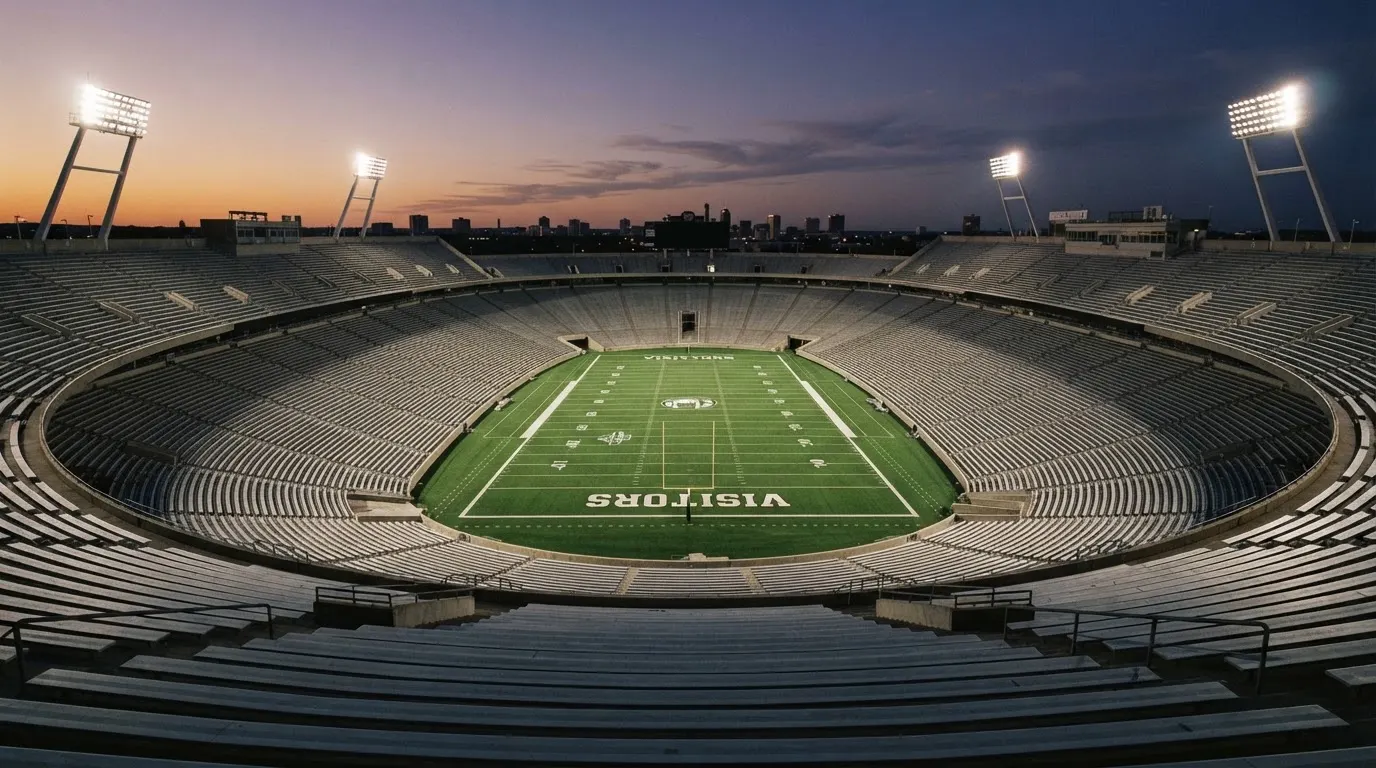
The scoring grid itself is short. A touchdown is six points. The attacking side then elects to kick an extra point, worth one, or run a two-point conversion from scrimmage, worth two. A field goal from the kicking tee is three points. A safety, awarded when the ball carrier is tackled in his own end zone, gives the defending side two points. That is the lot. The points-per-game averages from a season tell most of the story a casual viewer needs: a typical NFL total line sits around the mid-forties, and totals markets from 41.5 to 51.5 cover most regular-season games.
The league structure is the second fact a punter carries into the season. The NFL carries thirty-two franchises, sixteen in the American Football Conference and sixteen in the National Football Conference. Each side plays seventeen games across an eighteen-week regular season, and fourteen teams — seven per conference — reach the single-elimination playoffs that close the calendar. College football runs the NCAA structure with a four-team playoff that decides a national champion. The CFL and the XFL sit alongside the NFL as smaller professional circuits on which British bookmakers also price markets. Super Bowl LX was played on 8 February 2026 at Levi’s Stadium in Santa Clara, with Seattle beating New England 29-13 and Kenneth Walker III taking the MVP award — the last result of the most recent season rather than a pick for the next.
The statute: how betting on the sport is regulated in Great Britain
The Gambling Commission is the body that licenses the entire commercial gambling market in Great Britain under the Gambling Act 2005. England, Scotland and Wales are covered by that Act; Northern Ireland sits under an older and separate regime, which is why licence references in British gambling copy usually name Great Britain rather than the United Kingdom as a whole. Since the Gambling (Licensing and Advertising) Act 2014 an operator whose remote facilities are used in Great Britain needs a Commission licence wherever the operator itself is based — a Curaçao or Maltese or Gibraltar licence does not substitute.

A Commission account number is the test of whether a brand holds a GB licence, and the Commission’s public register can be searched by business name, trading name, domain or account number. The figures that get thrown around in marketing — “over two thousand licensed operators” — should never be quoted without the date of the access, since the register moves over the year. The bettor’s first stop when checking a brand is that register, not the brand’s own footer.
Licences come in categories. Remote general betting standard (real events) is the one most online sportsbooks hold; remote general betting standard (virtual events) is separate; remote pool betting is its own category and covers off-course pool betting on horse and dog racing; and the betting intermediary licence is what covers betting exchanges. Each licence holder is named on the register as the operating company, and several consumer brands can sit under one licensee — Ladbrokes and Coral under Entain, Paddy Power and Betfair under Flutter — which is why a brand name on a website and an account number on the register are not the same identifier.
The other rule that bites before a punter places a bet is identity. Since 7 May 2019 operators have had to verify name, address and date of birth before a customer can deposit or gamble — including with a free bet or a bonus. Anonymous play at a GB-licensed site is gone. That step happens before the first stake, which is a different shape from the days when bookmakers waved a customer through to the betting slip.
What may be bet on is not statutorily listed. Operators with a remote general betting licence for real events price markets under their own rules and the Licence Conditions and Codes of Practice, which is why in-play on American football is offered widely by GB bookmakers but each brand sets its own markets during a game. There is no statutory cap on stakes, and operators set maximums and customer-level restrictions themselves.
Wellbeing: the rules and tools that exist for a reason
GAMSTOP is the national multi-operator online self-exclusion scheme and a mandatory licence condition for every online bookmaker licensed in Great Britain. Periods run six months, one year, five years, or five years with auto-renewal, and after the minimum period the exclusion stays in force for a further seven years unless the customer asks GAMSTOP to remove it. The scheme covers online sites and apps; high-street betting shops run a separate self-exclusion register at shop level. A punter who wants to step back from the screen can register once and be excluded across every licensed operator without further paperwork.
The other control to know is the financial vulnerability check, in force for licensed remote betting from 28 February 2025 where a customer’s deposits minus withdrawals exceed £150 in any rolling 30 days. The check is a public-records look — bankruptcy, county court judgments — not an income or credit-reference check, which is the more intrusive step that has been discussed publicly and announced in stages but is not in force at a date the public rules can confirm. Operators must offer a gross deposit limit on a fixed time frame as part of the Remote Technical Standards; the first changes applied from 31 October 2025, a second phase was postponed to 30 September 2026, and whether that second phase is live depends on the date of reading. Deposit limits, product restrictions, time-out tools and self-exclusion are the standard kit a licensed operator publishes, and a punter who has not set a deposit limit with their bookmaker is paying in unspent discipline what a limit costs in foregone bets.
The help lines behind those tools run free. GamCare runs the National Gambling Helpline. GambleAware funds treatment and education. The NHS runs gambling clinics in several regions. Gamblers Anonymous runs local meetings. None of those is a substitute for the operator’s own controls, and the operator’s controls work only when a punter turns them on.
Crypto and anonymity: what the licensed market actually does
A search for “American football betting with Bitcoin” turns up plenty of results, and the licensed answer to that search is blunt: every bookmaker on the shortlist above is a Commission-licensed brand that verifies customer identity before the first deposit, and there is no GB-licensed route around that step. Bitcoin and other cryptocurrencies can be deposited only where the operator accepts them and where they sit inside the verification regime the licence sets, and the Commission’s money-laundering framework pushes licensed operators towards clearing crypto through the same identity and source-of-funds controls as a debit-card deposit. A licensed operator that takes Bitcoin will do so on its own terms, including the conversion to sterling at the time of deposit and the same identity checks that apply to any other payment.
The market that the crypto search returns is largely offshore — Curaçao, Anjouan, occasionally a Maltese licence that does not extend to Great Britain. Those brands are outside the GB licence frame and outside GAMSTOP, the 10x bonus cap, the £150 vulnerability check and the Commission’s complaints route. A reader who is drawn to a crypto route because it feels private is choosing, whether they realise it or not, to step off the register that names these protections and onto a register that does not. The funds held with an offshore operator sit outside the Commission’s reach when the operator refuses to pay out; the dispute resolution bodies approved by the Commission are for licensed brands only.
For a punt on American football specifically, the value of Bitcoin at a GB-licensed operator is roughly the value of a fast bank transfer that settles in pound sterling — it gets money in and gets bets on. A punter who wants to bet on the sport does not need a coin to do so, and the licensed bookmakers listed take debit cards and bank payments through standard rails without asking a punter to acquire crypto first.
Bonuses and free bets: what the headline number is actually buying
An American football sportsbook bonus is rarely a gift. The shape is almost always the same: a headline percentage, a multiplier the bonus must be turned over, a minimum price for bets that count, and a deadline. The Commission’s promotion rules in force from 19 January 2026 cap wagering requirements on bonuses at 10x the bonus amount — so a £10 bonus at 50x wagering, which used to be ordinary, is now over the line and would no longer be a permitted offer. Mixed-product promotions — an offer that ties a betting bonus to a casino or bingo or lottery element, the kind that used to read “bet on football to claim free spins” — are banned under the same rules.
A free bet is its own animal. The bookmaker credits a stake to the punter’s account and settles any winning selection as profit only — the original stake is not returned. A £10 free bet at decimal odds of 4.00, for example, returns £30 profit if it wins rather than the £40 a £10 cash stake would have returned. That difference is the price of the offer and the bit the marketing copy tends not to lead with.
A welcome offer is the page where the arithmetic gets done in earnest. A representative shape from the licensed set is “bet £10, get £30 in free bets” — and the realistic calculation behind it is what tells the punter whether it is worth taking. The bonus value to the punter, before any turnover on the deposit, depends on the free-bet value at the prices the punter will actually bet on, which on a margin-aware bookmaker runs lower than the headline. The headline number is the marketing; the expected value is the math.
A price boost, acca insurance and cashback are siblings of the free bet in the family tree. A price boost is a one-off enhanced price on a named selection, settled as a normal win. Acca insurance refunds a stake as a free bet or as cash if one leg of an accumulator lets the punter down. Cashback returns a percentage of net losses over a window, usually settled as a free bet or as bonus funds rather than as cash. None of those mechanisms is “free” — each has a turnover, a minimum price, a deadline, or a cap that strips some of the headline off the table.
A spread betting welcome, where the firm runs financial spread betting as well as fixed-odds, is the place a punter should read the small print twice. Spread betting losses can exceed the original deposit, which is not a marketing line — it is a regulatory line, since financial spread betting is regulated by the Financial Conduct Authority rather than the Commission and the liability sits on the punter’s side of the bet rather than at a fixed multiple of the stake.
Live betting and cash out: the game’s natural stoppages make it workable
American football is the easiest major American sport to bet in play, and that statement is structural rather than promotional. The game has built-in stoppages between plays, two-minute warnings at the end of each half, quarter breaks and challenges, which means there are natural windows during which a bookmaker can reprice a market without exposing the punter to the open-play chaos that makes live tennis pricing tricky. A price on the next play, the next drive, or the next scoring event can be updated between snaps with a reasonable footing for both sides.
Live streaming matters in that frame because the bookmaker cannot show live pictures to UK customers on every game without the rights, and which games each bookmaker streams is its own decision. DragonBet publishes live streaming on racing; BetVictor publishes enhanced live race streaming on horse racing; 10bet publishes Live Streaming across its sportsbook. American football coverage on those streams tends to be game-by-game and depends on rights deals in the United States — a punter should not assume that any one operator streams every NFL game.
Cash out is the second feature on the in-play shelf. A cash-out button is the bookmaker offering to settle a bet early at a price the bookmaker itself has set, and that price is the bookmaker’s margin at work in real time. The mechanic is honest, but the price offered is rarely the true price that the market would pay to close the position, because the bookmaker is buying the bet back on its own terms. Cash out is useful as a way to lock a profit or cut a loss when a game has gone one way in the first three quarters and the bettor does not want to sit through the rest — that is its legitimate use. It is a poor substitute for the original analysis.
For a punt on the NFL specifically, the timing of prices matters more than the headline odds. NFL lines move in the hours before kickoff, and the closing line — the price set just before the ball is kicked — has historically been the most accurate predictor of the result. A punter who takes a price on Tuesday and watches the price tighten by Sunday has locked in value; a punter who waits until the last minute often pays the wrong side of the move. Live betting is best treated as a second chance to enter a position at a fair price, not as a place to discover the game for the first time.
Predictions and strategy: what a tip actually is
A tip in the betting sense is a claim that a particular outcome is more likely than the price on it implies. Behind that claim are several inputs in this order: the tipster’s read of recent form, the statistics that read has been built on, the line-ups that are known at the moment the tip is published, the price the market has set on the outcome, and the tipster’s estimate of the true probability. The combination of those inputs is what a tip actually is, even when the tip sheet says only “Kansas City -3 at home”.
The first thing to know about any tip is that it is a probability claim, not a guarantee. Across a season of NFL tips, the line between a sharp tipster and a loud one is the record against the closing line, not the headline number of winners. A tipster who wins 60% of bets at short prices may be marginally profitable; a tipster who wins 60% of bets at long prices is taking value against the bookmaker. A tipster who publishes a record measured in units returned rather than in winners is closer to the truth.
Bankroll discipline is the second leg of any serious strategy. A flat stake — the same amount on every bet — keeps a tipster in the game when the variance of a short season runs against them; a variable stake in proportion to perceived edge is the way sharp bettors build their position over a year. What both have in common is that no individual bet is large enough to damage the bank when it loses, and that is a rule the marketing copy on welcome offers never quite spells out.
The third leg is logging. Every bet placed, the price taken, the closing line, the result, and the running profit-and-loss figure is the dataset that tells a bettor whether their method actually works. Without that log, a tipster is guessing at their own edge; with it, they are measuring it. The log is also the place to watch out for the survivor bias of past tipsters — the tip sheets that publish winners, not the bets that lost in the same week.
The fourth and dullest leg is the search for value rather than winners. A price of 2.10 (decimal) on a coin flip is not value even though it would win 50% of the time; the bookmaker’s margin is 4.5% on that market and the price offered is below fair. A price of 2.20 on the same coin flip is value, because the true probability is closer to 50% and the price offers more than 100% of stake back on average. Most weeks, a bettor’s edge is small and the losses on individual bets are part of the variance rather than evidence the method is broken.
Bet types and odds: how a price is built and what it pays
A bet on American football has the same vocabulary as a bet on any sport the licensed bookmakers price, plus a handful of American football-specific names. A single is one selection. A double is two, a treble three, an accumulator four or more — often shortened to “acca” in British usage. Each-way is two bets at equal stake, one on the win and one on a place, so the stake doubles. A Trixie is four bets from three selections (three doubles and a treble); a Patent is seven bets from three selections (three singles, three doubles and a treble); a Yankee is eleven; a Lucky 15 is fifteen; a Super Yankee, sometimes called a Canadian, is twenty-six; a Heinz is fifty-seven; a Goliath is two hundred and forty-seven. Each system multiplies stake by number of bets, so a £1 Lucky 15 stakes £15 in total.
A bet builder — labelled same-game multi at some bookmakers — combines several selections from the same game into one accumulator. A bet on Patrick Mahomes to throw over 2.5 touchdowns and the Chiefs to win, for example, is a two-leg same-game multi. The price is the combined price of the selections with the bookmaker’s margin layered over the top of each leg and again over the combination.
A handicap — also called a spread — gives one side a points advantage on the scoreboard for the purposes of settling the bet. A line of Kansas City -3 means Kansas City has to win by more than three points for the bet on Kansas City to win. A line of +3 on the other side means that side wins the bet if it wins outright or loses by fewer than three. A handicap that lands exactly on the line is a push and the bet is made void, unless the bookmaker offers a tie as an explicit selection.
A total, or over/under, is a bet on the combined score. A total of 47.5 with the over selected wins if the combined score is 48 or more. Totals are also subject to the push rule on whole numbers.
A moneyline is the American name for a bet on the outright winner. The British bookmaker publishes it as the home/draw/away price on a game with no handicap, although draws are possible in the NFL and are sometimes offered as a third selection. The NFL’s structure of overtime means a bet on the outright winner is settled after overtime in the regular season and after overtime in the playoffs, with a small number of operators writing their own rules on which side of a tie the bet is settled at.
The odds themselves come in two formats in British usage. Fractional odds of 5/1 mean a £1 stake returns £5 profit plus the £1 stake back; decimal odds of 6.00 mean a £1 stake returns £6 total, of which £5 is profit. The two formats describe the same price; the conversion is decimal = a/b + 1, so 5/1 → 6.00, 11/4 → 3.75, evens → 2.00. The book’s short-price vocabulary — “odds-on” for anything shorter than evens — is what readers see most.
Spread betting, which is offered by Sporting Index and Spreadex as a separate product from fixed-odds, is a different beast. A stake is multiplied by the difference between the price quoted and the result, with the punter winning if their view was correct and the spread was more favourable than the result. The same regulatory caveat from earlier applies: spread betting losses can exceed the deposit. Spreadex is FCA-regulated for spread betting and Commission-regulated for fixed-odds; the two licences cover two different products on the same site.
How a price is built: the margin sits inside every quote
Every decimal price a bookmaker publishes has the bookmaker’s margin baked into it. The mechanic is short: take the reciprocal of each price on every outcome of a market, sum them, and the result is the share of every unit staked that the bookmaker returns to customers in the long run. The remainder is the margin — the slice of each unit staked that the bookmaker keeps on average.
The result is the same whether the sport is NFL, college football, Premier League or cricket, and the price of a given market is what the bookmaker’s risk team has decided the combined probabilities should sum to once margin is layered over them. On an illustrative two-way market at decimal odds of 1.90 and 1.90, the arithmetic is straightforward:
- The reciprocal of 1.90 is approximately 0.5263.
- Summing the two reciprocals gives approximately 1.0526.
- The reciprocal of that sum — the share of every unit staked that is returned to customers on average — is approximately 0.9503.
- The margin is 1 minus that figure, or roughly 4.97%, in the band of 5%.
A market with two equally likely outcomes priced at 1.91 and 1.91 carries a slightly lower margin; one at 1.85 and 1.85 carries a higher one. The band between roughly 2% and 8% covers most pre-match NFL markets at British bookmakers, with player props, same-game multis and live betting often running higher because the bookmaker is pricing outcomes with less data behind them. The headline number a punter reads off a betting slip is the price after the margin, and the price that would correspond to a fair market — no margin, every outcome priced to its true probability — would be 2.00 on each side of a coin flip.
The way the margin shows up in practice is that the punter pays the bookmaker before any tip is consulted. A £10 stake on a market with a 5% margin returns, on average across all bets on that market, £9.50 over the long run; the rest is the bookmaker’s take. Following tips that win at the punter’s claimed probability but at the bookmaker’s price leaves the punter behind the margin line from the first bet.
The implication for the punter is not “avoid betting” — the implication is to know the price they are paying for a bet. A price of 1.91 is a price for a 52.4% chance, by definition, on a bookmaker that runs no margin at all; on a bookmaker running a 5% margin, the same price implies the bookmaker sees the punter’s outcome as more likely than 52.4% and so prices it shorter than a true 1.91. The price the punter takes is never “what fair would be” — it is “what this bookmaker offers, with this margin, on this market”, and the difference is the cost of doing business.
Sports and tournaments: where the season’s action sits
The NFL is the centre of the British bookmaker’s American football offering, with the regular season running seventeen weeks from early September through early January, the playoffs into February, and the Super Bowl closing the calendar. Super Bowl LX was played on 8 February 2026 at Levi’s Stadium in Santa Clara, and the next edition will sit in the 2026/27 season by the time the next fixture list is published. College football runs the NCAA regular season from late August through January and a four-team playoff that settles a national champion in early January.
The CFL, based in Canada, runs its own season from June to November with the Grey Cup as the championship. The XFL and USFL have come and gone as smaller professional circuits, sometimes folded into the same umbrella under the United Football League brand, and British bookmakers price some of those games when the schedule is live. Arena football sits at the margins. A punter who wants markets across the year will watch the NFL playoffs and the Super Bowl in February, the college football national championship in early January, the NFL Draft in late April as an ante-post market on the next season’s win totals, and the CFL from June.
The British bookmaker’s price depth varies across that calendar. NFL week 1 lines are typically thin — not many customers, not much liquidity. NFL playoff lines and Super Bowl lines are deep, with player props, alternate handicaps and same-game multis on the showpiece game. College football lines are thinner again and the British bookmaker covers Power 5 conferences more completely than the Group of 5. A punter who wants NFL props at peak depth is best served a few days before kickoff, when price boosts and acca insurance tend to appear on the marquee games.
The other thing to know about the calendar is the time zone. Most NFL games kick off at 1pm, 4pm or 8pm Eastern on Sunday, which is 6pm, 9pm or 1am in the United Kingdom. Monday Night Football is 1am UK, Thursday Night Football is also 1am UK in the new format. Live betting at British bookmakers on those games runs through the small hours of the UK morning, and a punter who wants to bet on a late game in play will be betting on a phone when the rest of the household is asleep.
The operator reviews, and what they mean for an American football punter
What follows is a closer look at each bookmaker on the shortlist — what each is licensed for, what each offers on American football specifically, and where each sits on the spectrum between a deep NFL bookmaker and a sportsbook that handles the sport as one of many. The reviews assume the punter is sitting in Great Britain, has verified their identity at the operator, and is using pounds sterling.
BetVictor — a long-running sportsbook with horse racing as its centre of gravity
BetVictor has held a GB remote general betting licence for fixed-odds sports betting for years under BV Gaming Limited, with the licence number on the Commission’s public register. The brand’s strength is horse racing — Best Odds Guaranteed applies to UK and Irish racing, with the price taken paid at the higher of the early price or the starting price — and that strength shapes the rest of the product around it. Smart Stats and BetFinder are racing-led features, but the sportsbook on the same site covers American football with moneyline, handicap and total points markets on the NFL regular season and the Super Bowl.
What this means for an American football punter is that BetVictor is a sensible single-account choice for a punter whose interests span racing and gridiron, and a less optimal choice for a punter whose interests are gridiron-only — the racing features are surplus to requirement, and the operator’s headline promotions tend to be racing-led. The financial risk of any single bet is straightforward — fixed-odds liability capped at stake times price minus stake — and the safer-gambling controls on the site are deposit limits, time-outs and GAMSTOP self-exclusion. Verdict: BetVictor is a reliable choice for a punter seeking a combined racing and gridiron account.
10bet — a sportsbook built around football with American football inside it
10bet operates under Blue Star Planet Limited, with a Gambling Commission remote general betting licence for real events. The sportsbook’s product list is football-first — Premier League, Champions League, La Liga, Bundesliga — with tennis, horse racing and American football alongside. The in-product features the bookmaker publishes are Cash Out, Bet Builder and Live Streaming; Cash Out is offered across settled sportsbook bets (where the bookmaker’s rules permit), Bet Builder combines selections from a single game into an accumulator, and Live Streaming covers a curated list of events.
For an American football punter, 10bet is a mainstream sportsbook choice: full coverage of NFL and college markets on game day, a bet builder on American football lines with the standard push rules on whole numbers, and live betting on the bigger games. The site does not run its own app for the US product specifically; the live streams depend on rights agreements that change match by match. Verdict: 10bet is a sensible fit for a punter looking to centralize football and NFL betting, particularly those not requiring specialized racing features.
Lottoland — a lottery-first site with a sportsbook attached
Lottoland’s primary product is lottery betting — bets on the outcomes of international lottery draws — under EU Lotto Limited, with the Commission’s remote betting licence covering the sportsbook alongside. The app combines casino, lottery betting, sports betting and scratchcards, and American football is one of several sports on the sportsbook. The site does not pretend to be a deep sportsbook and the price depth on NFL is thinner than at a specialist sportsbook.
This makes Lottoland the right choice for a punter who plays the lottery and wants a sportsbook tacked on, and the wrong choice for a punter whose primary interest is American football specifically. The sportsbook is licensed under the same Commission account as the lottery product, the safer-gambling tools cover both, and the GAMSTOP registration applies across both. The verdict is that Lottoland is a one-stop-shop for a multi-product punter; a gridiron-first punter is better served elsewhere.
Bet600 — best odds guaranteed on racing, sportsbook on the rest
Bet600 runs under Tyche Tech Limited with a Commission remote general betting licence. The sportsbook publishes Best Odds Guaranteed on horse racing — if the starting price is bigger than the early or show price taken, the bet is settled at the SP — and prices American football on the same platform under standard moneyline, handicap and total markets. The product is not racing-exclusive; the sportsbook handles football, tennis, golf and the rest of the mainstream calendar.
For the American football customer, Bet600 is a sportsbook that takes the sport seriously without making it the headline. The features used during a game are Cash Out (where the bookmaker’s rules permit) and live betting on the bigger fixtures. Verdict: Bet600 suits a punter who appreciates Best Odds Guaranteed on racing and wants one account for the NFL season; those focused solely on gridiron might find more dedicated features elsewhere.
Sporting Index — spread betting by name, fixed-odds by licence
Sporting Index holds a Commission remote general betting licence for fixed-odds sports betting under Sporting Index Limited, and runs a separate financial spread betting product under the FCA’s regulatory umbrella. The distinction matters on the punter’s side: fixed-odds betting is what a regular punter expects, with a stake and a price and a profit. Spread betting is a different product altogether — the punter’s liability is multiplied by the difference between the price quoted and the result, and that liability can exceed the original deposit.
The welcome offer on the app illustrates the shape: a £10 fixed-odds bet at minimum odds of 1/2 unlocks three £10 fixed-odds free bets, three £5 Total Goals spread bets, three £5 Winning Favourites spread bets and a £1 Race Index spread bet, with the qualifying bet not placeable in play or cashed out early. A punter who follows the offer through should treat the fixed-odds element as a free-bet accumulator and the spread-bet element as a separate product where losses can exceed the deposit. Verdict: Sporting Index is well-suited to the experienced spread bettor looking to manage both product types, but should be avoided by punters who are not fully clear on the differences.
BetTom — a smaller brand with a sports welcome and a casino twin
BetTom operates under Bet Tom Limited with a Commission remote betting licence for real events. The sports welcome offer is 50% back as a free bet of up to £50 with a parallel casino offer of 50% back up to £50 as free slot funds — the mixed-product structure is the kind that the Commission’s promotion rules in force from January 2026 are designed to constrain, so a punter reading the offer should check the live terms directly with the operator. Full terms apply at the bookmaker.
For American football, BetTom is a smaller-site sportsbook with mainstream market depth on the NFL and lighter coverage of college football. The bet builder is offered on the bigger games, in-play is offered on the bigger fixtures, and acca insurance runs across the major sports. Verdict: BetTom appeals to a punter seeking a smaller bookmaker experience with a sports-focused welcome package, though those preferring straightforward betting offers may look to alternatives.
Geoff Banks — an ante-post bookmaker with live in-play alongside
Geoff Banks is published by GB Sports Advisors Limited under a Commission remote betting licence for real events. The product is built around horse racing — ante-post markets on future events, live in-play prices once a race begins — with American football inside the sportsbook alongside football, tennis and golf. The ante-post angle is the brand’s angle: prices are available weeks before the event, with rules on non-runners and withdrawals that are visible before the punter stakes.
For the American football punter, Geoff Banks is a sensible place to stake an ante-post bet on the Super Bowl winner or on a season win total — a bet placed in the summer, settled in February — at a price the bookmaker has committed to. Live betting on the same app covers in-play markets on the bigger events. Verdict: Geoff Banks is an effective platform for the ante-post specialist building season-long positions on NFL futures, rather than one designed for frequent, weekly wagering.
Star Sports — an independent bookmaker with a multi-product site
Star Sports describes itself as the UK’s leading independent bookmaker and runs under Star Racing Limited with a Commission remote betting licence. The product list goes wider than most independents — virtual sports, casino, live casino and the sportsbook alongside horse racing. American football is one of several sports on the sportsbook with standard moneyline, handicap and total markets on the NFL calendar.
The independent angle is more a positioning than a feature: Star Sports trades on service as much as on price, with the kind of customer-care infrastructure that an independent bookmaker has historically built around racing. For the American football punter, the product is mainstream: live betting, bet builder, cash out (where rules permit) and a multi-product offer mix. Verdict: Star Sports offers a solid independent betting environment suitable for those balancing racing and gridiron, but may lack the specialized depth of larger, volume-focused sportsbooks.
Fitzdares — premium betting on racing and the major sports
Fitzdares holds a Commission remote betting licence for real events under Fitzdares Limited, with a premium positioning across the product. The brand publishes cash out, accumulators, Lucky 15s, specials and ante-post markets on horse racing, football, tennis, rugby, cricket, golf and American football, with in-play live odds on the bigger events. The premium angle shows up in the specials and the customer account management rather than in the headline odds.
For an American football punter, Fitzdares is a sportsbook with deep coverage of the major sports and a particular strength on ante-post and specials. The app surfaces accumulators as a promoted product type; in-play on American football runs on the bigger games. Verdict: Fitzdares aligns with the needs of a punter focusing on ante-post and special markets, whereas those looking for pure gridiron-weekly depth could explore other options.
DragonBet — a smaller bookmaker with cash out and racing streams
DragonBet runs under DragonBet Ltd with a Commission remote betting licence for real events. The bookmaker publishes Cash Out both in-play and pre-match, alongside live streaming of racing. American football is a standard sportsbook category on the same product, with the major markets priced week-to-week.
For the American football punter, DragonBet is a smaller sportsbook with Cash Out on in-play positions where the rules permit, and live streaming on racing as a distinctive feature that does not directly serve a gridiron customer. The bet builder is offered on the bigger games, and acca insurance runs across the major sports. Verdict: DragonBet provides a community-focused experience for those valuing transparency in cash-out terms across multiple sports, though it might not satisfy a punter demanding the most exhaustive NFL pricing.
Frequently asked questions on American football betting
How does a bet on American football work?
A bet on American football is a stake against a price on a named outcome — the outright winner, a handicap, a total, a same-game multi or a player prop. The price is published in decimal form (or in fractional form, converted by decimal = a/b + 1), and a winning bet returns stake times price. A losing bet returns nothing. Whole-number handicaps and totals can push, in which case the stake is returned. The market the bet is in — pre-match or in-play, single-game or futures — sits inside the operator’s terms, and the licence holder is the entity on the Commission’s public register against which any dispute is heard.
What is American football betting, in plain terms?
American football betting is the activity of staking money on outcomes of NFL games, college football games, the CFL and adjacent competitions. The activity covers outright winners, handicaps, total points, player performance propositions and the same-game multi combinations of those selections. Every licensed bookmaker serving British customers runs American football markets; not every bookmaker runs every market in every game, and a punter who wants player props needs to compare what each bookmaker prices on a given week.
Where are the best odds on American football found?
The best odds on a given market are the highest prices across licensed bookmakers serving the same selection, and the comparison is automated by odds-tracking sites for the bigger events. A punter comparing prices should check three or more bookmakers and place the bet at the best price available, factoring in any account-level offer that applies. The “best” price is not the headline promotion — it is the closing line of the market, the price the bookmakers settle on just before kickoff, because that price has historically been the most accurate predictor of outcomes. A punter who routinely takes prices below the closing line loses slowly; a punter who routinely takes prices above it gains slowly.
What is a value bet, and why is no tip ever certain?
A value bet is a bet at a price longer than the probability the bettor estimates, such that the bet returns more on average than the stake risked. The shape is durable: across many bets at the same edge, the bettor makes money. A tip is a probability claim dressed as a prediction, and no probability claim is certain — even at 95% confidence, one in twenty events goes the other way. A tipster who claims certainty is selling certainty that does not exist. The reliable signal of a tipster’s edge is the record against the closing line, measured over hundreds of bets rather than tens.
What is the bookmaker’s margin, and how does it show in the odds?
The bookmaker’s margin is the slice of every unit staked that the bookmaker keeps on average, calculated as 1 minus the share of stakes returned to customers across all outcomes of a market. On an illustrative two-way market at decimal odds of 1.90 and 1.90, the margin is in the band of 5%, meaning the bookmaker keeps around five pence of every pound staked on that market across many bets. The same margin applies across markets on the same operator, varying with the depth of pricing on each market and the operator’s risk appetite. The margin is the cost of doing business with a bookmaker, and the punter who knows the margin on their chosen market is paying the bill with eyes open.
How is the return on a bet worked out from the stake and the odds?
The return on a winning bet is stake times decimal odds, of which profit is stake times decimal odds minus stake. A £10 stake at decimal odds of 3.75 returns £37.50 in total (£27.50 profit plus £10 stake). A combination bet’s price is the product of each leg’s decimal odds; a treble at 3.00, 2.50 and 1.80 returns stake times 13.50 if all three legs win. A free bet returns profit only, not stake — a £10 free bet at decimal odds of 4.00 returns £30 profit on a win. The arithmetic is short; the application across hundreds of bets is where the variance of a betting bank lives.
US & other team sports – Socceroddshub.com
Content created by the «Socceroddshub.com» team
