
How boxing betting odds are built and where to find the best price in 2026
 Available in US
Betting on boxing is not the same as betting on football. The number of fights a bookmaker prices in any given week is small; each bout offers a narrow set of markets, and prices move sharply on weight-cut news, hand injuries and a late change of opponent. This page goes through what the odds mean, what they cost the punter, which markets the licensed UK bookmakers actually run, and what sits behind the welcome offers that show up around a big card. The aim is to leave a reader able to read a price, judge a margin, and pick a bookmaker on facts rather than on whatever banner last flashed across the screen.
Current as of October 30, 2026: licensing data verified against the Gambling Commission’s public register; operator terms verified against each operator’s own pages on the snapshot date.
Reading a price, seeing the margin
The first number a bookmaker shows is the price, and the second number — the one that decides whether the price is generous or stingy — is the margin the bookmaker has built into it. A “50/50” fight at 1.91 / 1.91 sounds generous until the math is done; the same fight at 1.80 / 1.80 looks mean but might actually be the better deal. The rule holds anywhere a market has more than one outcome: take the implied probability of every price (1 divided by the decimal odds), add them up, and the surplus over 100% is the bookmaker’s edge. That edge is the margin.

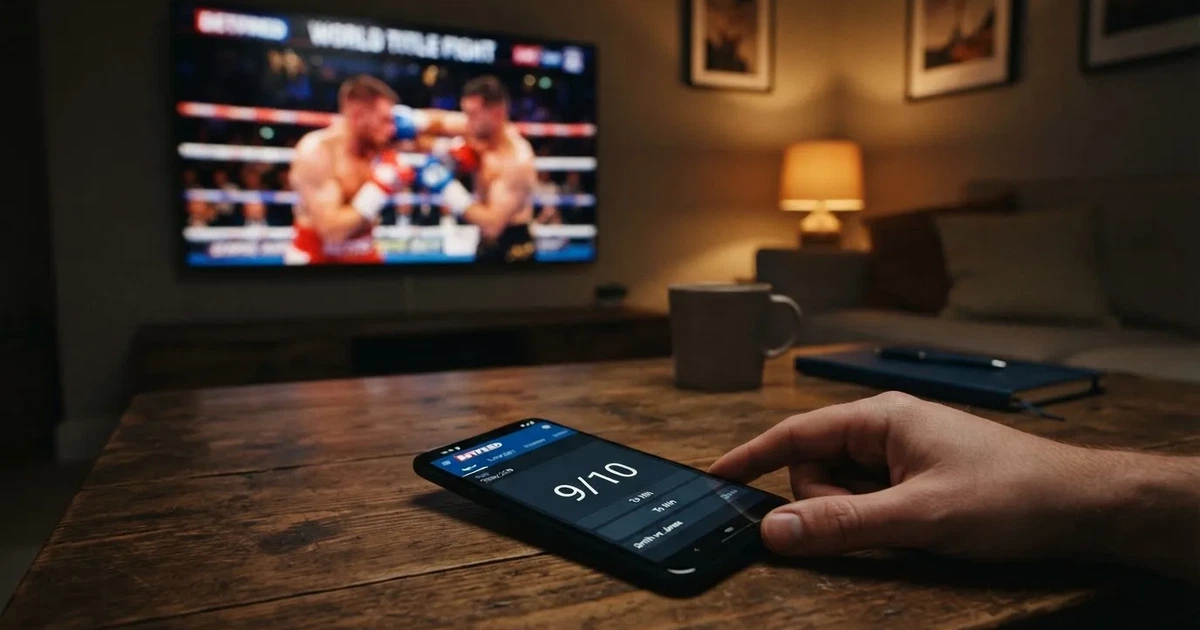
A worked example makes it concrete. Take an illustrative two-way bout priced at 1.90 / 1.90 — fractional 9/10, the kind of line a bookmaker might post on a pick-’em fight. Implied probability on side A is 1 ÷ 1.90 = 52.63%, on side B the same 52.63%, and 52.63% + 52.63% = 105.26%. The bookmaker’s margin sits in a 5–6% band, and the payout share to the punter is roughly 94–95%. In other words, for every £100 staked across both fighters over many bets, the bookmaker keeps roughly £5.26 and returns £94.74 in winnings. The narrower the prices sit around 2.00, the closer the margin is to zero; the more they sag towards 1.50 or balloon towards 5.00, the more one-sided the market is, and the more carefully a margin should be read because the implied probabilities are no longer balanced.
A bookmaker offering 1.85 / 1.85 on the same illustrative bout keeps 8.11% of every pound; 1.80 / 1.80 keeps 11.11%. That is the difference between a market that pays back 91.89p per pound staked and one that pays back 88.89p — about three pence per pound, every time the bet wins. Boxing markets tend to fall in the 5–10% margin band on outright winner pricing; method-of-victory and round-band markets sit higher because the number of outcomes is larger, and accumulators compound the margin across every leg.
A margin does not predict the next fight. It tells the punter how much the bookmaker takes for providing the market, in the same way a casino takes a cut of every hand. Over a single bet the difference is invisible. Over a season of bets, it is the largest single number in the long-run result.
The markets a boxing card actually offers
A title fight is a small event by betting standards: a dozen bouts on the undercard, a handful of markets on each, and prices that can be wider or tighter than the headline fight because the bookmaker has less information to lean on. The markets that show up across most UK-licensed bookmakers fall into a handful of families.

Outright winner. Two boxes, two names, one winner-market per bout. Method of victory (KO/TKO, decision, draw) usually comes as a three-way or four-way market, and draw sits at a long price because the sport settles on a winner the vast majority of the time. The winner market on a high-profile title fight is the deepest and most efficient market on the card.
Method of victory. A four-way or six-way market depending on whether the bookmaker breaks out KO/TKO and decision separately, and whether disqualification is priced. The margins here are wider than on the outright winner because there are more outcomes and each one is less frequent. A punter laying a method bet should expect a margin north of 8–10% on most fights.
Round betting and round groups. Round of stoppage, or round group (rounds 1–3, 4–6, 7–9, 10–12 in a twelve-round bout). The four-round fights common for newer professionals are priced in their own groups. Round-band markets carry the widest margins on the card because they divide a small probability mass into a dozen slivers.
Total rounds over/under. A line set at, say, 8.5 rounds — over pays if the fight goes past the halfway mark of the ninth round, under pays if it ends inside that mark. The mechanics are the same as a totals bet on football, and the margin usually sits between outright winner and round group.
Fight to go the distance. A yes/no market on whether the judges’ scorecards settle the bout. Yes prices are typically shorter on championship-distance fights where both fighters are durable.
Outright tournament winner. The price on a fighter to win a tournament bracket — World Boxing Super Series-style or the forthcoming season-ending formats. Only available during a tournament.
Bout markets beyond the winner. Fights going past a certain round, the fighter to be knocked down first, fighter to win a specific round, and method combined with round (e.g. “Fighter A by KO in rounds 7–9”). These are conditional markets and the margins widen sharply with each condition stacked on top of the last.
The accumulator has its own place in boxing, and a different math. A four-fold acca multiplying the prices of four favourites at 1.40 each pays 1.40 × 1.40 × 1.40 × 1.40 = 3.84. The margin on each leg is small, but stacked together the overround is wider than on any single bet, and one losing leg takes the whole ticket down. acca insurance — a refund as a free bet if one leg lets you down — does not change the math on the winning tickets, only the cost of the losing ones.
What the licensed UK bookmakers look like on a boxing card
There is no single “best” UK bookmaker for boxing. There are bookmakers that price the marquee fights tightly, bookmakers that go harder on the undercard, and bookmakers that run an in-play product better than a pre-match one. The list below is in the order research mapped them; it is not a ranking. What follows is what each platform’s own pages say it offers, and the licence number on the Gambling Commission’s public register that backs the claim to operate in Great Britain.
BoyleSports (UK Gambling Commission account 39469) — BoyleSports’ sports welcome offer for UK players is £20 in free bets when a £10 bet is placed, with the Irish equivalent of €30 in free bets for a €10 bet. Beyond the offer, BoyleSports prices the major fights on its boxing page and runs the standard winner / method / round markets. The bonus is a free bet, and the stake is not returned with a win: the qualifying £10 bet is paid out at face value, the £20 of free bets is paid out as winnings only.
Hollywoodbets (UK Gambling Commission account 53028) — Hollywoodbets’ sports welcome offer for new UK players refunds the stake as a free bet of up to £30 on the first qualifying losing accumulator: deposit £10 or more by card, place an acca of £10 or more with three or more legs at combined odds of 4/1 or greater, settled within seven days of placement, and one free bet per customer. A reader who picks a single, or who backs a short-priced favourite, will not trigger the refund — the offer is shaped for accumulator punters, not singles bettors.
Bet600 (UK Gambling Commission account 44731) — Bet600 pays Best Odds Guaranteed on horse racing: if the starting price is bigger than the early or show price taken, the bet is paid at the SP. That rule does not apply to boxing, but the broader implication — a bookmaker that pays out at the better of two prices — is the kind of operator that tends to price tighter markets. For boxing the product is the standard winner / method / round markets.
Tote (UK Gambling Commission account 54779) — Tote is the pool-betting brand of the UK horse-racing pool, but the site carries a sportsbook with boxing markets under a remote general betting standard (real events) licence. Pricing on boxing is a smaller line than at the high-street names.
Unibet (UK Gambling Commission account 45322) — Unibet has operated since 1999 and its UK site is run by Platinum Gaming Limited out of Gibraltar. The sports welcome offer is £40 in free bets when a £20 bet is placed at minimum odds of 2.0 (1/1), with free bets expiring within seven days of issue for new GB customers using a debit card or instant bank transfer. Unibet’s boxing card runs the standard markets plus in-play pricing on the bigger fights.
Coral (UK Gambling Commission account 54743) — Coral’s sports welcome offer mirrors Unibet’s in shape: £40 in free bets when a £20 bet is placed at minimum odds of 2.0 (1/1), with the free bets issued within seven days and expiring seven days after issue, for new GB customers who opt in. Coral’s product covers the standard boxing markets and an in-play line on the major fights.
DragonBet (UK Gambling Commission account 64908) — DragonBet’s app is published by DragonBet Ltd and features Welsh football and rugby, racing, American football, in-play betting and bet builder markets. The boxing offering is part of a smaller line aimed at a UK and Welsh audience.
DAZN Bet (UK Gambling Commission account 48756) — DAZN Bet’s deposits start at £5 by debit card, Apple Pay, Paysafecard, Trustly and Skrill, and at £20 by PayPal, with no processing fees. DAZN Bet’s boxing pricing sits behind the DAZN streaming paywall in places and offers the standard markets, with stronger pricing on fights the DAZN platform is showing live.
Matchbook (UK Gambling Commission account 39504) — Matchbook is a betting exchange where customers bet against other users, with Bet Builder, multiples, in-play betting and live streaming of horse racing and greyhounds. An exchange is a different market from a sportsbook: the “odds” are set by the users, the bookmaker takes a small commission on net winnings, and the price a backer gets is closer to the true probability than at a fixed-odds book. Boxing liquidity is thinner than on football, so prices can be wider between matches and tighter as fight night approaches.
Betfred (UK Gambling Commission account 39544) — The Betfred Sports, Casino & Games app is published by Done Brothers (Cash Betting) Ltd and covers 21 sports plus over 2,000 casino-style games. The boxing line is part of a wider sportsbook that prices the major fights and a long undercard. Betfred’s pricing tends to be sharp on the bigger fights because the trading team has a long history with the sport.
A licence line and a welcome offer do not make a verdict. The verdict below is the page’s own judgement of each operator for the punter who wants to bet on boxing specifically.
BoyleSports suits a punter who already has an account and wants a thin welcome offer to top up the balance. The £20 on a £10 bet is modest, the conditions are short, and the offer is shaped for someone who is going to bet anyway.
Hollywoodbets suits an acca bettor. The refund is on a losing accumulator of three or more legs at combined odds of 4/1 or more, which is the shape of a small-stake Saturday acca rather than a single-bet welcome.
Bet600, Tote, DragonBet and DAZN Bet each carry a smaller boxing product; they suit a punter who already uses the operator for another sport and wants a single account.
Unibet and Coral suit a punter chasing the headline welcome offers. The £40 on a £20 bet at minimum odds of 2.0 is the largest free-bet amount on the list, and the seven-day expiry is short enough that the punter needs to use the free bets on a card they have already planned to bet on.
Matchbook suits a price-sensitive punter. An exchange pays closer to true probability because there is no bookmaker margin built in, but liquidity on boxing is thinner than on football or horse racing, so the best price can sit on the screen for minutes rather than seconds and then disappear.
Betfred suits the long-shot punter. The deep sportsbook and a trading team that has priced British boxing for decades tend to give a competitive undercard line.
What governs the UK market, and who enforces it
Boxing betting in Great Britain sits inside the same legal frame as every other sport covered by the Gambling Act 2005. The Gambling Commission licenses operators, the ASA enforces the advertising rules, and HM Treasury takes the operator’s tax through General Betting Duty. No separate statute covers boxing specifically.
A bookmaker taking remote bets from customers in Great Britain needs a Gambling Commission licence; since the Gambling (Licensing and Advertising) Act 2014, the licence is required wherever the operator is based. A Curaçao, Maltese or Gibraltar licence is not a substitute. Northern Ireland sits outside the 2005 Act and has its own older law — a GB licence is not a Northern Ireland licence.
The Commission’s public register lists every licensed operator and is searchable by business name, trading name, domain or account number. The licence categories that cover boxing are remote general betting standard (real events) for sportsbook products and remote betting intermediary for exchanges. There is no statutory list of permitted sports or markets: an operator holds a licence for a category and offers markets under its own rules and the Licence Conditions and Codes of Practice.
The player pays no tax on betting winnings in Great Britain. General Betting Duty is the operator’s tax on gross profits — 15% today, with a new 25% remote rate from 1 April 2027 on remote bets outside UK horse racing, self-service betting terminals, pool betting and in-person betting. Whether operators pass the duty on through the odds is not established. No statutory cap on stakes in sports betting was found: operators set their own maximum stakes and may restrict individual customers.
Advertising is governed by the CAP Code (non-broadcast) and the BCAP Code (broadcast), enforced by the ASA alongside the Commission’s marketing conditions. The codes require marketing not to be of strong appeal to under-18s and limit the role of under-25s in advertisements; the codes do not say who may bet, only how an operator may advertise. “Whistle-to-whistle” — the absence of betting ads from five minutes before to five minutes after a live sporting event on TV before the 9pm watershed, since 1 August 2019 — is an industry code, not a statute, and excludes horse and greyhound racing.
The Premier League’s voluntary withdrawal of gambling sponsorship from the front of matchday shirts from 2026/27 is a commercial one, not law. Boxing has no equivalent at the time of writing.
Player protection, and what the licensed bookmaker is required to offer
Every UK-licensed remote operator is a member of GAMSTOP, the national multi-operator online self-exclusion scheme. Self-exclusion periods are six months, one year, five years, or five years with auto-renewal, and after the minimum period the exclusion stays in place for a further seven years unless the customer asks GAMSTOP to remove it. GAMSTOP covers online sites and apps; betting shops use a separate over-the-counter self-exclusion service.
Identity verification happens before a customer can deposit or gamble, and it is not optional: since 7 May 2019 a UK-licensed bookmaker must verify name, address and date of birth before the first bet, including a bet made with a free bet or bonus. The corollary is that anonymous play does not exist at a licensed site. The corollary is also that the bookmaker has the data needed to honour a self-exclusion request within minutes.
A financial vulnerability check (LCCP condition 3.4.4, in force since 30 August 2024) applies when a customer’s deposits minus withdrawals exceed £150 in a rolling 30 days, since 28 February 2025. The check is a public-record check (bankruptcy, county court judgments and the like), not an income check and not a credit reference check. Financial risk assessments — the “affordability checks” of the press — are announced in a staged plan with no start date at the time of writing, so write “announced, staged, no start date”.
Deposit limits are a customer-set tool, not a state-set ceiling: the Commission’s Remote Technical Standards require operators to offer a gross deposit limit on a fixed time frame. The first phase has applied since 31 October 2025; a second phase was postponed to 30 September 2026. There is no state-set deposit or loss ceiling for betting in Great Britain.
Help: GamCare runs the National Gambling Helpline. GambleAware funds treatment and education. The NHS runs gambling clinics in England. Gamblers Anonymous runs peer-support meetings.
The credit-card ban is the one payment rule with a fixed date: credit cards have been banned for gambling in Great Britain since 14 April 2020, including credit-card-funded payments through an e-wallet. Debit cards and bank-based payments are not covered by that ban. The identity-verification rule means a source-of-funds question at higher spend is normal under the money-laundering rules. There is no state list of permitted payment methods, no rule against cryptocurrency deposits at licensed operators and no British named-account rule beyond the anti-money-laundering framework.
The bonus cap that came into force on 19 January 2026 limits wagering requirements on bonuses to 10x — a £10 bonus at 50x needed £500 of qualifying bets; under the cap, no more than £100. Mixed-product promotions — an offer that requires gambling on two or more product types such as betting, casino, bingo and lottery — are banned. Whether the cap applies to free bets with no wagering condition is not established.
Crypto, anonymity, and the offshore bookmaker
Cryptocurrency sits awkwardly inside a UK-licensed product. The identity-verification rule that applies before the first deposit at any UK-licensed operator means a punter cannot bet with bitcoin or any other coin without going through the same checks as a debit-card deposit — name, address, date of birth, and at higher spend a source-of-funds check. The Commission has not banned cryptocurrency deposits at licensed sites; it has set the conditions high enough that anonymous play does not happen. The licensed bookmakers on this page do not run a crypto-native product.
A bookmaker that prices boxing without a Gambling Commission licence is operating outside the 2005 Act. The Commission’s enforcement is disruption — cease-and-desist notices, search-engine referrals, work with registrars, hosts and payment providers — and the Commission has been given, or is about to receive, court-order DNS blocking powers. There is no ISP-level filter in operation at the time of writing. Providing gambling facilities in Great Britain without the licence the Act requires is an offence under section 33 of the Gambling Act 2005, aimed at the operator. No offence aimed at a customer who merely bets on an unlicensed site was found, but the protection is gone: no GAMSTOP coverage, no Commission complaints route, no approved dispute-resolution body, no British consumer redress if funds are withheld, and the bonus cap and the £150 vulnerability check do not apply. “Legal to use” is the wrong frame; “loses the protections of a UK licence” is the right one.
A betting exchange licensed as a remote betting intermediary is still a UK-licensed product, and Matchbook on this page runs on exactly that licence. The math on an exchange is different: prices are set by users against each other, the bookmaker takes a small commission on net winnings, and the backer gets closer to the true probability than at a fixed-odds sportsbook. The trade is liquidity: football and horse racing attract deep liquidity, boxing attracts less, and the best price can sit on the screen long enough for a punter to take it.
Welcome offers, free bets, and what the bonus actually costs
Every bookmaker on this list runs a sports welcome offer, and every offer is a free bet rather than a cash bonus — the stake is paid out as winnings only, not as stake plus winnings, when the bet wins. That is the structure, not a marketing line.
A worked example: a £20 free bet on a selection at decimal odds of 4.00 returns £20 × (4.00 − 1) = £60 in profit if it wins. The stake is gone. A £20 cash bet on the same selection returns £20 × 4.00 = £80, of which £60 is profit and £20 is stake returned. The £20 difference is the cost of taking the free bet. Free bets are not free in money; they are a stake the bookmaker gives the punter to play with, with the stake forfeited on a win.
The turnover requirement is the second number. A £10 bonus at 10x wagering needs £100 of qualifying bets before any winnings can be withdrawn; the 19 January 2026 cap limits that to £100 of qualifying bets on a £10 bonus, so a £40 free bet at 10x needs £400 of qualifying bets. The qualifying bets must be at the minimum price the offer sets — usually 2.0 (1/1) on singles, sometimes 1/5 (1.20) per leg on accumulators. The minimum price is the hinge the punter should read first, because the cost of clearing the bonus depends on it.
A back of bookmaker bets at minimum odds of 2.0 sits in a market with a margin of about 5% on a two-way bout; £400 of qualifying bets at a 5% margin costs £400 × 5% = £20 in expected loss. The free bet was worth £20 in expected value at the start of the process, and the clearing process costs £20 — the punter is approximately whole. That is the industry shape: a welcome offer at a UK-licensed bookmaker is roughly even-money between the value of the free bet and the cost of clearing the wagering requirement. The punter’s edge is the time and effort, and the punter’s loss is the edge of the bookmaker across the qualifying bets.
The third number is the deadline. Unibet’s free bets expire within seven days of issue, Coral’s within seven days, BoyleSports’s standard terms sit in the same band. A punter who takes a free bet and forgets about it loses the whole amount. The deadline is the part of the offer that costs the punter the most in practice, because a missed deadline is a 100% loss rather than a 5% margin.
The fourth number is the cap on free-bet winnings. Some bookmakers cap the winnings on a free bet at a multiple of the free bet; others cap at a flat amount. The cap is in the terms, and a punter who backs a 50/1 outsider on a free bet and wins gets the cap, not the long price.
Accumulator insurance — a refund as a free bet if one leg lets the acca down — is a different shape. Hollywoodbets’ welcome offer is built around exactly that mechanic: refund the stake as a free bet up to £30 on a first qualifying losing accumulator of three or more legs at combined odds of 4/1 or greater, settled within seven days. The cost of the refund to the bookmaker is the cost of the refund to the punter, and the punter’s expected gain is the difference between the cost of the refund and the cost of the lost acca stake. The expected gain is positive on a small number of accas and negative on a large number, depending on the prices and the leg count.
Mixed-product promotions — an offer that requires gambling on two or more product types such as betting, casino, bingo and lottery — were banned on 19 January 2026. A punter who sees “bet on boxing to get free spins” should know the offer does not exist at a UK-licensed bookmaker.
Mobile, app, and the in-play product
Boxing is a sport where the in-play product does more of the work than the pre-match product. A bout can change on a single punch, and a punter who can place a bet between rounds has access to information that did not exist when the market opened. Every UK-licensed bookmaker on this list offers in-play betting on boxing for marquee fights; the question is how deep the in-play product goes.
bet365 carries in-play betting and live streaming of events worldwide, with Bet Track, Match Live and a Live Golf Tracker for following bets in play. The boxing in-play product includes Bet Builder+ — combining markets from one event into a single bet — and Super Boosts, Winnings Boosts on Bet Builders and selected singles, and daily Bet Boosts. The mid-fight offering is the deepest in the licensed UK market.
Unibet and Coral carry the in-play product on major fights with a thinner set of markets, and the live-streaming product is smaller. The pricing on in-play markets tends to be wider than on pre-match markets because the bookmaker has less information and less time to hedge.
DAZN Bet sits inside the DAZN streaming paywall in places, and the boxing pricing on fights the DAZN platform is showing live tends to be sharper because the platform can tie the live feed into the pricing engine.
Matchbook runs in-play as an exchange, with prices set by users against each other and a small commission on net winnings. Liquidity on boxing in-play is thinner than on football or horse racing, but the price can be closer to the true probability than at a fixed-odds book.
DragonBet runs in-play betting and bet builder markets on its app, with the boxing product part of a smaller line aimed at a UK and Welsh audience.
The mobile experience matters because a punt on a fight is usually placed on a phone, in a sports bar, in the few minutes before the bell. An app that takes three taps from the home screen to a confirmed bet is a different product from one that takes eight taps. The download count on the App Store is a rough proxy for how polished the product is; the product itself has to be tested by the punter who will use it.
Live betting and cash out
The cash-out button is the second thing a bookmaker offers after the price. A punter can lock in a profit (or a loss) on an open bet before the fight settles; the price on the cash-out is the bookmaker’s live quote, and the quote carries a margin of its own. A punter who cashes out at 2.00 on a bet that opened at 3.00 has taken a smaller win than waiting for the result, but the win is locked.
Cash-out is a useful tool when the fight is going against the bet: a punter who backed the favourite and the favourite is down on the cards can cash out for a small loss and avoid a total loss. Cash-out is a costly tool when the fight is going with the bet: the bookmaker is offering a smaller win than the bet would pay, and the punter is paying the cash-out margin to lock in less than the open bet is worth.
Some bookmakers offer partial cash-out — a percentage of the bet is settled, the rest stays open. The mechanic is the same as full cash-out, with a smaller stake locked in.
The in-play product and the cash-out product are not the same product. A bookmaker can offer a strong in-play line and a thin cash-out product (the cash-out margin widens against the punter), or a thin in-play line and a competitive cash-out product. The punter who uses both should compare both.
The licensed bookmakers and what they actually do
This section pulls the operator list into a single view. The columns are the four matters the comparison turns on: the brand, the Gambling Commission remote licence number and licence holder, and what the operator’s own terms state on boxing.
| Brand | Gambling Commission remote licence | Licence holder | What the operator’s own terms state |
|---|---|---|---|
| BoyleSports | 039469-R-319383-025 (Commission account 39469) | Boylesports Enterprise | £20 in free bets when a £10 bet is placed for UK players; standard boxing markets on the major fights. |
| Hollywoodbets | 053028-R-330019-013 (Commission account 53028) | Hollywoodbets International UK Limited | Refund as a free bet of up to £30 on the first qualifying losing acca (3+ legs, 4/1+, settled in 7 days); one free bet per customer. |
| Bet600 | 044731-R-323941-016 (Commission account 44731) | Tyche Tech Limited | Best Odds Guaranteed on horse racing; standard boxing markets on the major fights. |
| Tote | 054779-R-331321-008 (Commission account 54779) | TDCO Limited | Pool-betting brand; sportsbook with boxing markets under the remote general betting standard (real events) licence. |
| Unibet | 045322-R-324275-019 (Commission account 45322) | Platinum Gaming Limited | £40 in free bets when a £20 bet is placed at minimum odds of 2.0 (1/1); free bets expire within 7 days. |
| Coral | 054743-R-330863-014 (Commission account 54743) | LC International Limited | £40 in free bets when a £20 bet is placed at minimum odds of 2.0 (1/1); free bets expire 7 days after issue. |
| DragonBet | 064908-R-339041-003 (Commission account 64908) | DragonBet Ltd | App features Welsh football and rugby, racing, American football, in-play and bet builder markets. |
| DAZN Bet | 048756-R-327274-019 (Commission account 48756) | DZBT Limited | Deposits from £5 by debit card, Apple Pay, Paysafecard, Trustly and Skrill; from £20 by PayPal; no processing fees. |
| Matchbook | 039504-R-319407-024 (Commission account 39504) | Triplebet Limited | Betting exchange where customers bet against other users; Bet Builder, multiples, in-play, live streaming. |
| Betfred | 039544-R-319290-010 (Commission account 39544) | Petfre (Gibraltar) Limited | 21 sports and over 2,000 casino-style games; standard boxing markets on the major fights and undercard. |
The licence holder is the legal entity named on the Commission’s register against the trading name. Several brands can run under one licensee; the trading name is the brand the punter sees, and the licence holder is the company behind it.
Boxing itself: the sport the odds describe
Professional boxing bouts usually run ten to twelve rounds, with four-round fights common for newer fighters; each round lasts three minutes with a one-minute rest between rounds. A bout is won by knockout, technical knockout (a stoppage by the referee, doctor or corner), a decision on the judges’ scorecards, or disqualification for fouls. A draw happens when the judges give both fighters equal scores.
The WBA, WBC, IBF and WBO sanction world championships in professional boxing. Each body keeps its own rankings, and a fighter who holds one of the four belts is a world champion in that body’s title; an “undisputed” champion holds all four.
The structure of the sport shapes the betting product. A twelve-round championship bout offers round groups in three-round bands (rounds 1–3, 4–6, 7–9, 10–12); a four-round fight offers a single round group (rounds 1–4) on round betting. The number of rounds is in the bout contract, and the round groups are set by the number of rounds.
A draw is a small but real outcome in boxing: judges can score a bout a draw, and a draw at championship level is rarer than at club level but not vanishingly rare. The draw price on a title fight is usually in the 25/1 to 66/1 band.
Strategy and what it means in a sport this small
A “strategy” in boxing betting is less elaborate than in football or horse racing. The market is small enough that a single piece of information — a hand injury in camp, a late change of opponent, a weight cut that did not go to plan — moves prices sharply. The strategy is to read the price for the information it carries, and to back or lay accordingly.
The first move is to compare prices across bookmakers. Boxing is small enough that one operator’s line can be 1.80 while another’s is 1.91 on the same fighter, and a price-conscious punter takes the bigger price. The third bookmaker’s price is the test: a market of depth has prices within 0.05 of each other across the major bookmakers; a market of thinness has prices 0.10 or more apart.
The second move is to compare prices over time. A fighter’s price drifts from 1.50 to 2.00 over the week of the fight because the news is bad; the price that opened is the price the bookmaker thought was right, and the price that sits on fight night is the price the market has moved to. The punter who has watched the news knows whether the drift was justified.
The third move is to read the method market as a check on the outright winner market. A fighter at 1.40 on the outright line and 5.00 on “to win by decision” is a fighter the bookmaker expects to win early. Alternatively, if the same fighter is priced at 2.50 for the method, the bookmaker expects the win but is less certain of the path. The two numbers together are more informative than either alone.
The fourth move is to stay small on accumulators. The margin on each leg is small, and the margin across four legs is wider than on any single bet. A four-fold acca on four favourites at 1.40 each pays 3.84, and the bookmaker’s edge on the ticket is the overround of all four legs compounded. The edge is the same as on a single bet, but the variance is four times higher and one losing leg takes the whole ticket down.
The fifth move is to skip the welcome offer if it does not fit. A free bet that needs to be used within seven days is a free bet that does not fit a punter who bets once a month. The expected value is the same, but the deadline turns the offer into a forced bet the punter would not otherwise have placed. A forced bet at a price the punter would not have taken is a forced loss.
How to check a licence yourself
The Gambling Commission’s public register is at the Commission’s website and is searchable by business name, trading name, domain or account number. The four pieces of information on the licence record are the licence number, the licence holder, the trading name(s) and the licensed activities. A licence number that begins with a remote licence prefix is a current account; an entry that has expired sits in a separate section of the register.
The trading name is not the same as the licence holder. Ladbrokes and Coral trade under LC International Limited; Paddy Power and Betfair trade under PPB Entertainment Limited; BoyleSports trades under Boylesports Enterprise. A punter who searches the register for “Coral” finds LC International Limited; a punter who searches for “LC International Limited” finds Ladbrokes and Coral together. The licence holder is the legal entity; the trading name is the brand.
The licensed activities matter. Remote general betting standard (real events) covers the sportsbook. Remote betting intermediary covers a betting exchange. Remote general betting standard (virtual events) covers virtual sports; a bookmaker that holds the real-events licence does not necessarily hold the virtual-events licence. A bookmaker that holds only the virtual-events licence does not price real boxing.
The domain on the register is the licensed domain. Licensed operators use .com as well as .co.uk, so the domain proves nothing about whether the operator is licensed. A punter who sees a .com should check the register, not assume the brand is unlicensed.
The math on the back of a betting slip
The arithmetic on a betting slip is small enough to do in the head. The return on a winning single is stake × odds, and the profit is stake × (odds − 1). A £10 single at 3.00 returns £30 of which £20 is profit; a £10 single at 1.50 returns £15 of which £5 is profit.
The arithmetic on an accumulator multiplies. A four-fold acca at 1.50, 1.80, 2.00, 3.00 pays 1.50 × 1.80 × 2.00 × 3.00 = 16.20; a £10 stake returns £162. One losing leg takes the ticket down. The stake on a Lucky 15 (15 bets: 4 singles, 6 doubles, 4 trebles, 1 four-fold) is 15 × unit stake; the ticket pays on whichever combinations win.
The arithmetic on a free bet is stake × (odds − 1) — the stake is not returned. A £20 free bet at 4.00 returns £60 of profit; the £20 stake is gone. The arithmetic on a cash bet is stake × odds; the stake is returned.
The arithmetic on a margin is 1 minus the payout share. The payout share on a 1.90 / 1.90 market is 1 ÷ (1 ÷ 1.90 + 1 ÷ 1.90) = 1 ÷ 1.0526 = 94.74%; the margin is 5.26%. The arithmetic on a margin of a wider market is the same. The arithmetic on a margin of a round-group market with eight outcomes at 8.00 each is 1 ÷ (8 × 0.125) = 1 ÷ 1.00 = 100% — meaning the prices together imply no margin and the bookmaker has not built one in, which is the sign of an unpriced market rather than a generous one.
A reader’s checklist before placing a bet
The first check is the licence. The Commission’s register is searchable by trading name or domain; the licensed activities tell the punter what the bookmaker is licensed to offer, and the licence number tells the punter who holds the licence.
The second check is the price. Two prices on the same fighter at two different bookmakers, and the punter takes the bigger. Three prices, and the punter takes the median. A price that sits 0.10 away from the median is a price worth questioning.
The third check is the margin. Implied probabilities added up, the surplus over 100% is the bookmaker’s edge. A margin above 10% on the outright winner is wider than the market for the sport; a margin above 15% is wide on any market.
The fourth check is the welcome offer. The stake is a free bet, the wagering requirement is in the terms, the minimum price is the hinge, and the deadline is the part that costs the punter the most in practice. A punter who reads the deadline first loses less than a punter who reads the headline offer first.
The fifth check is the payment method. Credit cards are banned for gambling in Great Britain; a bookmaker that takes a credit card is breaking the LCCP. The credit-card ban includes credit-card-funded payments through an e-wallet.
The sixth check is the self-exclusion. GAMSTOP is the national scheme; a punter who has self-excluded cannot bet at any UK-licensed operator until the exclusion period ends and a further seven years have passed.
The seventh check is the help line. GamCare runs the National Gambling Helpline. The NHS runs gambling clinics. Gamblers Anonymous runs peer-support meetings. A punter who needs help has a place to call.
Frequently asked questions
How is a boxing bet placed?
Pick the bout, pick the market — outright winner, method of victory, round group, total rounds — and add the selection to the betting slip. Type the stake, check the price has not moved, and confirm. The bookmaker takes the stake from the cash balance or, for a free bet, from the free-bet balance. A winning selection pays stake × odds on a cash bet and stake × (odds − 1) on a free bet.
How does boxing betting work in the UK?
Boxing betting in Great Britain is licensed by the Gambling Commission under the Gambling Act 2005. Every bookmaker taking remote bets from customers in Great Britain needs a Commission licence, and the licence is required wherever the operator is based. The Commission’s public register is searchable by trading name or domain and is the test of who holds one. A licensed bookmaker verifies the punter’s name, address and date of birth before the first deposit and is a member of GAMSTOP.
Can boxing be bet on online?
Yes. Every operator on this page takes remote bets through a website or an app, licensed for customers in Great Britain by the Gambling Commission. The verification rules mean there is no anonymous play at a licensed site, and the welcome offers tend to be free bets rather than cash bonuses.
How is a Gambling Commission licence checked?
Search the Commission’s public register by business name, trading name, domain or account number. The record lists the licence number, the licence holder, the trading names and the licensed activities. A remote licence that covers boxing sits under remote general betting standard (real events); a betting exchange sits under remote betting intermediary. The licence number is unique and does not change between trading names under the same licence holder.
How is the return on a bet worked out from the stake and the odds?
Decimal odds are the simplest form: multiply the stake by the decimal odds. A £10 stake at 3.00 returns £30. The profit is stake × (odds − 1), so a £10 at 3.00 makes £20 of profit. On a free bet, the stake is not returned, so the return is stake × (odds − 1) and the profit is the same as the return. Fractional odds convert by stake × (a ÷ b) + stake, or stake × (a ÷ b + 1).
Combat & motorsport – Socceroddshub.com
Content created by the «Socceroddshub.com» team
